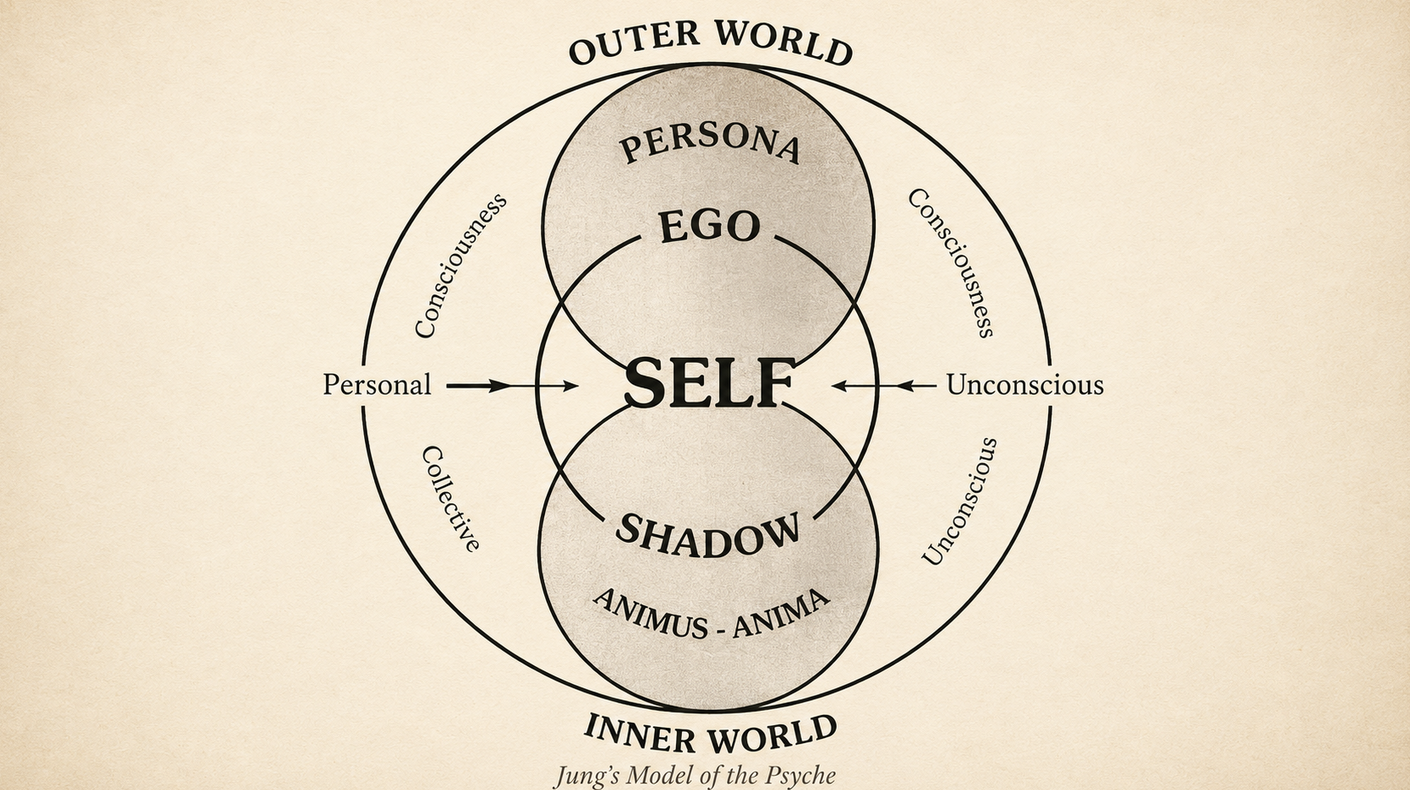
You already know more about Jungian psychology than you think. If you have ever caught yourself despising a quality in someone else that, on honest reflection, lives in you too—that is Jung. If you have ever performed a version of yourself so convincingly that you started to forget where the performance ends—that is Jung. If a dream has ever delivered an image so strange and so charged that you could not shake it for days—that is Jung’s territory more than anyone else’s.
The trouble is that most people meet Jung in fragments. A shadow work prompt here, a personality type there, an archetype quiz, a quote of disputed origin floating across social media. The fragments are intriguing, but they hide the fact that Jung built a coherent map—a way of understanding why the inner life behaves the way it does, and what it might be asking of us.
This guide is jungian psychology explained as a whole: the map of the psyche, the figures that populate it, the forces that move it, and the lifelong process Jung believed it all serves. By the end, the fragments should click into place.
Where Jungian Psychology Came From
Carl Gustav Jung (1875–1961) was a Swiss psychiatrist who began his career doing something surprisingly empirical. In the early 1900s, working at a psychiatric hospital in Zürich, he ran word-association experiments. He would read a list of ordinary words—table, water, mother, money—and time how long a person took to respond.
He noticed something simple and profound. Certain words produced a hesitation. The person would stumble, blank, or give an oddly strained answer—and often had no idea they were doing it. Jung concluded that emotionally charged material was clustered around certain themes in the psyche, interfering with conscious functioning from below. He called these clusters complexes, and the word entered everyday language. When someone says “she has a mother complex,” they are quoting Jung, usually without knowing it.
This matters for how you read everything that follows. Jung’s strangest ideas grew from a concrete observation: there is something in us that reacts before we do, that has opinions we have not approved, and that leaves fingerprints on our behavior.
The break with Freud
For several years Jung was Freud’s closest collaborator and presumed heir. They split in 1913, and the core disagreement is worth understanding, because it defines Jungian psychology.
For Freud, the unconscious was essentially a basement of the repressed—primarily sexual and aggressive material pushed out of awareness. Jung agreed the basement existed, but he believed it was only the first level down. Beneath the personal material, he argued, lay something deeper, older, and not merely pathological: a creative, purposive layer of the psyche shared by all human beings.
After the break, Jung went through a long period of profound disorientation, what he later called his “confrontation with the unconscious.” Rather than flee the flood of dreams and inner images that came to him, he recorded and engaged with them deliberately, treating his own crisis as research material. Much of this work later surfaced in The Red Book. Whatever one makes of it, the point is striking: Jung’s concepts are not armchair theory. They are field notes from a descent. That is part of why his work still speaks to people whose inner lives have become turbulent; he drew the map while lost in the terrain himself.
The Map of the Psyche
Jung once described a dream in Memories, Dreams, Reflections that serves as a diagram of his whole model. He dreamed he was in the upper story of a house—a comfortable, furnished salon. He descended to the ground floor and found it older, medieval. Below that, a Roman cellar. And beneath the cellar, a cave cut into rock, scattered with bones and fragments of primitive pottery.
The house, he came to believe, was the psyche. The lit, furnished room at the top is the part you know. Everything below is also you.
The ego: the room with the lights on
The ego is Jung’s term for the center of conscious awareness; the “I” that remembers your name, plans your week, and tells the story of your life. It is real and necessary. Without a functioning ego, there is no one home to do any of this reflecting.
But Jung’s foundational claim, the one every other concept depends on, is that the ego is not the whole personality. It is one room in a much larger house, and it tends to mistake itself for the whole building. Much of what we call inner conflict, in Jung’s view, is the friction between the ego’s self-image and everything in the psyche that contradicts it.
The personal unconscious: your own basement
One level down lies the personal unconscious: everything that belongs to your individual history but is not currently in awareness. Forgotten memories. Perceptions you registered without noticing. And, most importantly, material that was pushed down because it conflicted with who you needed to be; the anger that wasn’t allowed, the grief that was inconvenient, the ambition that felt dangerous.
This material does not lie inert. It organizes itself into complexes—those charged knots Jung found in his word experiments. A complex behaves like a sub-personality with its own emotional logic. You know you have touched one when your reaction outsizes the situation: the criticism that ruins your whole day, the certain tone of voice that makes you feel eight years old. Jung’s famous observation was that everyone knows people have complexes—what is less known is that complexes can have us. In those moments, the ego is not driving.
The collective unconscious: the cave beneath the cellar
Below the personal layer, Jung proposed something more controversial: the collective unconscious. His claim was that humans do not arrive as blank slates. Just as we inherit a body with a common anatomy, we inherit a psyche with common structural tendencies—shared dispositions to form certain kinds of images and respond to certain kinds of situations: the mother, the hero’s trial, the wise elder, death and rebirth, the descent into darkness.
He called these inherited dispositions archetypes, and here is the distinction most popular accounts get wrong. An archetype, for Jung, is a form rather than a picture. He compared it to the lattice structure of a crystal: the lattice determines the crystal’s possible shape, but no two crystals are identical. You do not inherit an image of “the mother.” You inherit a readiness to form mother-images—and the specific images that grow on that lattice come from your own life, your culture, your wounds.
This is why no dream symbol carries one universal meaning. The deep pattern may be shared; the expression is always personal. Any approach to symbols that hands you a fixed dictionary definition has already left Jung behind.
A note on credibility, because it deserves a plain answer: the collective unconscious and archetypes are not empirically established in the way mainstream experimental psychology requires. Jungian psychology is best understood as a depth-psychological framework for meaning-making—clinically practiced, intellectually serious, enormously influential on therapy, literature, and film—but not laboratory-proven science. Jung’s defenders point to the striking recurrence of mythic patterns across unconnected cultures; his critics point out that recurrence can be explained in other ways. You can use the map without treating it as scripture. Jung himself, at his best, held his ideas as working hypotheses about an unknowable interior.
The Figures on the Map
If the layers describe the psyche’s architecture, Jung’s most famous concepts describe its inhabitants—recurring figures through which the unconscious presents itself.
The persona: the negotiated face
The persona is the face you have developed for the world: competent at work, easygoing with friends, patient with family. Jung borrowed the word from the masks worn by actors in antiquity, but he did not mean it as an insult. The persona is a necessary achievement. Social life would be unbearable without it, and a person with no persona at all is not authentic—they are simply hard to be around.
The danger Jung identified is subtler: identification with the persona. This is when the mask stops being something you wear and becomes something you are—when there is alarmingly little behind the role.
The classic scenario, which Jungian writers like James Hollis have described in depth, arrives at midlife or after a rupture. The career ends, the children leave, the marriage that defined you dissolves—and the person discovers that the role was holding up the whole structure. The flatness, the “who am I now?” vertigo that follows, is in Jungian terms the collapse of a persona that had quietly swallowed the personality.
There is a useful self-test hiding here: the more rigid and total the persona, the larger the shadow it casts.
The shadow: the unlived life
The shadow is Jung’s name for everything the ego has excluded in order to maintain its self-image. Every persona is built by selection, I am kind, I am rational, I am strong, and everything edited out does not vanish. It collects in the dark, just behind you, where you cannot see it but others sometimes can.
Two corrections to the popular version:
- The shadow is not simply your “evil side.” It contains whatever was disowned—and in a punishing or self-effacing upbringing, what gets disowned is often vitality, anger that could have become healthy assertiveness, sexuality, spontaneity, even talent. Jungians call this the golden shadow: the gifts we buried alongside the faults. A telling sign of golden shadow is intense envy—the friend whose creative work makes your chest tighten may be carrying a capacity you abandoned in yourself.
- The shadow is felt before it is seen. Its experiential signature is a double charge: things that repel and fascinate at the same time. The dark figure in a dream that terrifies you yet keeps appearing. The person you cannot stop criticizing. That mixture of fear and pull is, in Jungian terms, the unmistakable signal of unconscious content that carries energy the ego needs.
A more accurate definition of the shadow than “dark side” might be the unlived life—everything you could have been and were not allowed, or did not allow yourself, to be.
Anima and animus: the inner other
Jung observed that deep in the psyche there often appears a figure of the opposite sex—in dreams, in fantasy, and most powerfully in the people we fall for. He called this inner figure the anima in men and the animus in women, describing it as the contrasexual side of the personality: the qualities a person’s gendered upbringing taught them to leave undeveloped.
Jung’s original formulation reflects his early-twentieth-century assumptions about gender, and contemporary Jungians often frame it more flexibly: each of us carries an inner “other”—an interior figure embodying the relational, imaginal, or assertive capacities our identity excluded, whatever our gender.
What makes the concept practically useful is what it explains about love. When you meet someone and feel, instantly and overwhelmingly, that they are everything, that they complete you, Jung would say you have projected this inner figure onto a real person. The intoxication of early infatuation is partly the experience of meeting your own unlived soul wearing someone else’s face. The disillusionment that often follows, when the actual human fails to match the image, is the projection coming home. Whether a relationship survives that moment, Jungians suggest, depends on whether two real people remain once the images are withdrawn.
The Self: the larger center
At the deepest level of the model sits what Jung called the Self—capitalized to distinguish it from the everyday ego. The Self is his term for the totality of the psyche, conscious and unconscious together, and for an organizing center within it that seems to aim at wholeness.
This sounds mystical, and Jung approached it through a strikingly concrete observation. During his own years of disorientation, he found himself spontaneously drawing circular, symmetrical images—what he later recognized as mandalas, the sacred circles found in contemplative traditions worldwide. He noticed that these images tended to appear, in himself and in his patients, precisely during periods of inner chaos—as if something in the psyche were drafting blueprints of order when order was most absent.
His inference: there is a self-regulating, self-ordering tendency in the psyche that is larger than the ego and not under its control. The ego is the room with the lights on; the Self is the whole house, including an intelligence in the architecture. Whether you read this psychologically, spiritually, or somewhere in between is genuinely open—Jung himself was careful to describe it as a psychological reality, an experience people have, rather than a metaphysical proof.
The Dynamics: How the Psyche Moves
Concepts are static. What makes Jungian psychology feel true in daily life are its dynamics—the characteristic ways the unconscious acts on us.
Projection: meeting yourself in other people
Projection is the mechanism by which we encounter our own unconscious material in other people. What the ego cannot admit in itself, it perceives, vividly, convincingly, in someone else.
The reliable marker is disproportion. Plenty of people are mildly annoying; projection announces itself when your reaction has heat that the facts cannot justify. The colleague whose naked ambition disgusts you, beyond all reason—while your own ambition sits in the shadow, disowned because somewhere you learned that wanting things openly was shameful. The friend whose neediness you cannot tolerate, while your own needs go unfed and unspoken.
Jung’s uncomfortable proposal is that our strongest judgments of others are often a map of our own shadow. Not always—sometimes a difficult person is simply difficult—but the disproportionate charge is always worth a second look. Projection works in the golden direction too: relentless idealization of a mentor or partner often means you have handed them qualities that belong to you.
The practical question Jungian psychology teaches you to ask is small but corrosive to self-deception: Why this person? Why this much?
Compensation: the psyche’s counterweight
Here is the idea that, more than any other, separates Jung from Freud, and makes Jungian dream work coherent.
Freud read dreams primarily as disguises, smuggling forbidden wishes past an inner censor. Jung read them as compensation: the unconscious balancing a one-sided conscious attitude, the way the body regulates temperature. The psyche, in this view, behaves like a self-correcting system, and dreams are its corrections.
This is why the relentlessly positive, endlessly accommodating person may keep dreaming of being chased by something furious. The dream is not random horror—it carries the anger the daytime personality refuses to feel, and it will keep arriving until the message is received. The over-controlled person dreams of floods and rising water. The person whose life has become all surface dreams of basements, locked rooms, and figures in the dark.
Compensation changes how you read any symbol. The question is never “what does a flood mean?”—there is no fixed answer. The question is “what conscious attitude might this image be answering?” The symbol is a response to your one-sidedness, which is why the same image can mean different things in different lives. This single idea is the difference between Jungian interpretation and a dream dictionary.
Complexes: when something else is driving
Worth returning to, because it is the most everyday of Jung’s ideas. A complex is an emotionally charged cluster in the personal unconscious—typically formed around early wounds—that activates under specific conditions and temporarily takes over.
You can recognize a complex by its signature:
- The reaction is faster than thought and bigger than the trigger.
- It feels ancient, as if you have felt exactly this before.
- Afterward, you half-recognize that “I wasn’t myself.”
- The same theme recurs across different relationships and decades.
The Jungian aim is not to eliminate complexes—Jung doubted that was possible—but to know them well enough that they no longer operate invisibly. A complex you can feel arriving has lost most of its power.
How Jungians Work With the Unconscious
Jung’s methods follow from his model. If the unconscious is purposive and communicates in images, the work is learning its language.
Dreams and amplification
Jungian dream work begins with respect for the image itself. Rather than translating a dream symbol into a fixed meaning, Jung practiced amplification: circling the image, gathering its associations—personal first, then cultural and mythic—until its resonance becomes clear in the context of this dreamer’s life.
A snake in your dream is not automatically “transformation.” The working questions are different: What is a snake to you? What was it doing in the dream, and how did you feel? What is going on in your waking life that this image might be compensating? The meaning emerges from the conversation between the image and your situation, never from a lookup table.
One Jungian habit transfers immediately into ordinary life: take repetition seriously. A recurring dream, a recurring image, a recurring conflict—repetition suggests the psyche has something it considers unfinished. The unconscious, Jung observed, tends to repeat itself until it is heard.
Active imagination
Jung’s most distinctive technique was active imagination: deliberately engaging the figures of the inner world while awake—holding a dream image in mind and letting it move, speak, respond; sometimes writing the dialogue down, sometimes painting it. The aim is a genuine two-way exchange between the ego and the unconscious, rather than the ego’s usual monologue.
It is a powerful reflective practice and should be treated as such—reflective practice, not therapy. For most people it means little more than journaling with the imagination switched on. But if your inner material is intense, intrusive, or destabilizing, that is a signal to work with a qualified mental health professional rather than alone. Jung undertook his own descent with clinical training and considerable support; that context is part of the story too.
A Note on Personality Types (and MBTI)
Many readers arrive at Jung through the Myers-Briggs Type Indicator, so the relationship deserves a clear sentence: Jung did not create the MBTI, and it is not an accurate proxy for his thinking.
What Jung actually wrote, in Psychological Types (1921), introduced introversion and extraversion—his coinages—as two orientations of psychic energy, inward toward the inner world or outward toward objects and people. He paired these with four functions: thinking, feeling, sensation, and intuition.
Crucially, his system was dynamic and compensatory. Whatever function dominates consciousness, its opposite sinks into the unconscious and becomes part of the shadow—primitive, touchy, and prone to erupting under stress. The hyper-rational thinker is ambushed by moods and sentimentality; the feeling type is undone by cold, obsessive logic at 3 a.m. For Jung, your type described your one-sidedness—and therefore your developmental task—rather than a fixed identity to print on a profile.
The questionnaire industry froze this living system into stable labels. Jung’s version is less flattering and more useful: your type tells you where your shadow is.
Individuation: What All of This Is For
Everything above converges on one concept, which Jung considered the purpose of psychological life: individuation.
The word is often misread as individualism—becoming more uniquely yourself in a self-expressive sense. Jung meant something closer to becoming undivided: the lifelong process by which the scattered, disowned, and projected parts of the personality are gradually brought into relationship with consciousness, so that you become the whole of what you actually are rather than the fraction the ego approved.
In lived terms, the movement looks something like this:
- The persona loosens. You stop needing the role to be total. There is a person behind the face, and you know the difference.
- The shadow is owned. You withdraw projections—admitting that the qualities you condemned in others have a home address in you, and reclaiming the buried gold along with the faults.
- The inner other is met. The qualities you sought in idealized partners are slowly developed as your own, which paradoxically makes real love more possible, because you no longer need another person to carry your soul for you.
- The ego finds its size. It stops pretending to be the whole house and enters into dialogue with the Self—through dreams, through symbols, through attention to what keeps recurring.
Two honest corrections to the self-help version. First, individuation frequently begins with what looks like failure: the collapse of the persona, the eruption of long-suppressed material, the dark and disoriented passage that Jungian writers locate so often at midlife. The breakdown of the false arrangement is sometimes the first act of the genuine one. Second, individuation is never finished. Jung did not describe a destination at which one arrives, polished and complete. He described a direction—a lifelong widening of consciousness, with the shadow always regenerating at the edge of whoever you become next. Even your individuated self casts one.
What it offers is not perfection but a different relationship with yourself: less performance, fewer projections, more access to your own energy, and a strange companionship with the depths—the sense that the unconscious is not an enemy below the floorboards but something more like a difficult, intelligent partner.
What to Take With You
If Jungian psychology has a single sentence at its core, it is this: you are larger than the self you know, and the parts you have exiled have not gone away.
From that one claim, the whole system unfolds—and so do its practical instructions for daily life:
- Treat disproportionate reactions as information. When your response outsizes the trigger, a complex or projection is likely active. Ask what it touched.
- Study your strongest judgments. The people who repel or fascinate you beyond reason are often carrying pieces of your shadow—dark or golden.
- Read dreams as responses, not omens. Ask what one-sidedness in your waking attitude the image might be balancing. Distrust any source that gives a symbol one universal meaning.
- Notice what repeats. Recurring dreams, recurring conflicts, recurring images—repetition is the psyche underlining something.
- Keep a persona without becoming it. The mask is a tool. The question worth asking, periodically, is who remains when the role is set down.
- Follow your envy. It often points straight at abandoned capacities of your own.
Jung’s framework is not settled science, and a careful reader should hold it the way Jung held it—as a working map of territory that resists final measurement. But maps are judged by whether they help you find your way, and for over a century this one has helped people make sense of the dark figure in the dream, the inexplicable hatred, the hollow role, the recurring image that will not leave. It takes the irrational parts of you seriously, and proposes that they are not noise but messages.
The lights-on room where you live is real. So is the rest of the house. Jungian psychology, finally, is the practice of going downstairs.