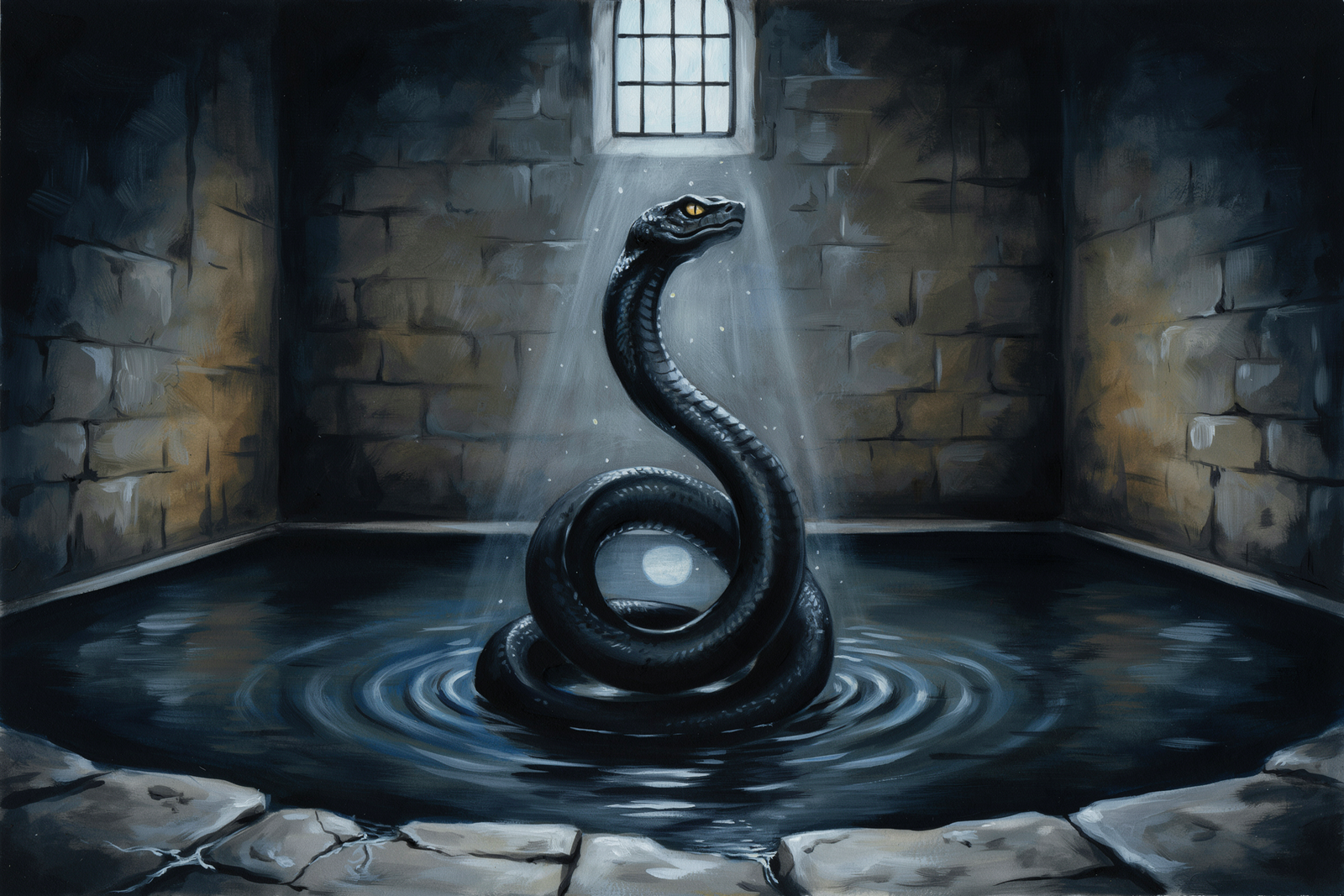
Snake dreams have a particular signature. You wake up and the dream has weight, the way most dreams do not. Something cold and articulate moved through it, and even hours later, brushing your teeth, you can still feel where it was looking at you from. That charge is the first piece of information. Before any interpretation, it tells you that something autonomous in the psyche has come close enough to be felt.
Jung was uninterested in dream symbols as vocabulary. He treated them as events. A snake arriving in a dream is not the unconscious sending a postcard with the word transformation written on it. It is the unconscious actually doing something, in the only language it has available, and the snake is the form that thing took because no other form would fit. That distinction matters. It is the difference between reading a tarot card and being bitten.
The Snake as the Part of You That Doesn’t Answer to You
In Symbols of Transformation, Jung situates the serpent at the deepest stratum of the psyche, where what he called libido (meaning psychic energy generally, not Freud’s narrower sexual sense) has not yet been domesticated into intention. It is instinct in its raw, pre-personal state. Cold-blooded. Indifferent. Not malicious, but not aligned with your projects either.
This is why dreaming of snakes feels different from dreaming of, say, a wolf or a stranger. Mammalian shadow figures usually still resemble you. The snake does not. It carries something older than personality, closer to the body itself, closer to whatever continues running while you sleep. When it appears, the dream is staging an encounter between your daylight self and the part of you that has never asked permission for anything.
The fear most people report is rarely fear of the snake. It is the felt distance between the conscious ego and whatever the snake carries. Wide distance, sharp fear.
Why It Came Now
Jung’s principle of compensation is the most useful lens here. The unconscious tends to dramatize what the waking mind is leaving out. If you have been living inside obligation, performance, careful management of other people’s moods, or any sustained over-identification with the rational and the controlled, the psyche compensates by producing something the ego cannot manage. A snake fits that brief almost too well.
So when readers ask why the dream came now, the more useful question is the inverse. What instinct, knowing, refusal, appetite, or somatic signal have you been overriding lately? Snake dreams cluster around thresholds: an ending you have not let yourself name, an attraction you have filed away, a body signal or tension you keep rationalizing away, a decision already made underneath the one you are still publicly debating.
The Image Isn’t a Verdict, It’s a Camera Angle
Jungian dream reading respects variation. A snake under the bed and a snake shedding its skin are not interchangeable. They are different shots of the same encounter.
A snake watching, motionless, is often the most significant variation. A watching snake is the unconscious noticing you back. That is threshold territory. Something has registered.
Being bitten can read, in the Asclepian and alchemical traditions Jung drew on, as wounding-as-initiation. The serpent image can heal and poison, a tension carried by medical and alchemical symbolism and explored throughout Jung’s later work. A bite means contact has been made with what you had been carefully not touching.
Killing the snake almost never reads as triumph. In the symbolic grammar Jung worked with, it tends to be the ego refusing the meeting. The figure usually returns, sometimes larger.
A nest, or a floor full of snakes, often points toward a complex: not one charged content but a constellation of them, knotted together. Shedding skin, on the other hand, is the rare image where the dreamer is being shown that the transformation is already underway, not pending. The work is happening whether or not the ego has consented to it.
How to Sit With It Without Flattening It
Resist the urge to assign a single meaning. The reason dream dictionaries feel hollow is that they collapse a living event into a static label, which is exactly the opposite of what the dream did to you. Yours arrived charged precisely because it was unrepeatable.
Try this instead. Note what the snake was doing, not just that it appeared. Note where you were in the dream, since domestic settings (your house, your bed, your childhood home) imply the instinctual content is entering personal territory, whereas wilderness settings imply you are entering its territory. Note what you did, since the ego’s reaction in the dream is itself information about how it currently relates to what it cannot domesticate.
Dreaming of snakes, in the Jungian frame, is rarely a warning and almost never a prophecy. It is a meeting. Something in you that has been living below the threshold of your attention has come up far enough to look at you. Whether it bites, watches, sheds, or simply waits, the dream is asking a question that does not translate cleanly into English, which is why it had to come as a snake in the first place.
Sit with it before you try to solve it. The snake is patient. It has nowhere else to be.