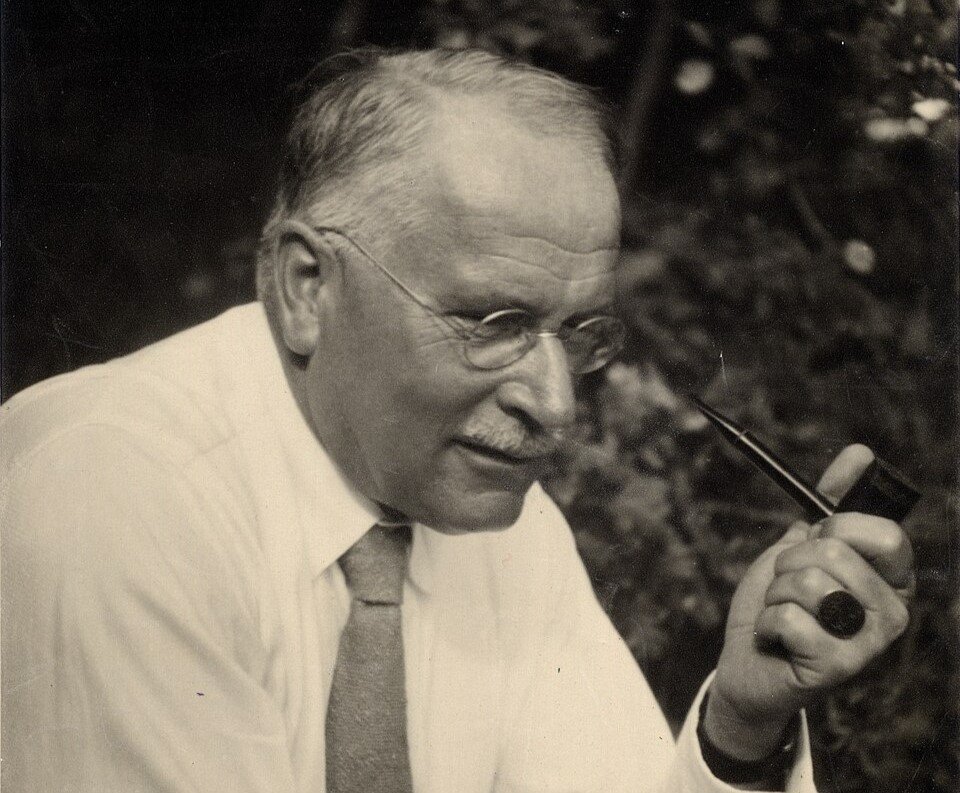
Most people arrive at Jung through the wrong door. They hear a few words first: shadow, archetype, dream symbolism, collective unconscious, anima, animus, synchronicity. Then, because these words sound mysterious, they either become fascinated too quickly or dismiss the whole thing as vague spiritual psychology. Both reactions are understandable, but both miss the more basic point.
Jungian psychology begins with a very simple disturbance: you are not only what you consciously know about yourself.
That is the first thing to understand. Not the shadow. Not dream dictionaries. Not the mandala. Not the wise old man, the trickster, the hero, or the mother archetype. Those things matter later, but the beginning is much more intimate and much more uncomfortable. You have a conscious personality, a name, a history, a set of opinions, a way of presenting yourself, and a story about who you are. But beneath that, beside that, and sometimes against that, there are other movements in the psyche.
You notice them whenever your reaction is larger than the situation. You notice them when a dream stays with you all day, even though you do not know why. You notice them when you keep choosing the same kind of person, the same kind of failure, the same kind of humiliation, even after you have supposedly learned the lesson. You notice them when you hate something in another person with a strange intensity, or admire someone with an intensity that feels almost religious.
Jung’s work is an attempt to take these things seriously.
Not necessarily literally. That distinction matters. Jung is not saying that every fantasy is true, every dream is prophetic, or every inner voice is wisdom. But he is saying that the psyche speaks before it explains itself, and that if you only listen to the part of yourself that is already rational, socially acceptable, and easy to describe, you are listening to a very small part of what you are.
The Ego Is Not the Whole Psyche
The first concept to get clear is the ego, because people often misunderstand Jung as if he simply wants us to dissolve the ego and become mystical.
That is not quite right.
In Jungian psychology, the ego is the center of consciousness. It is the “I” that says, “I am this kind of person, I want this, I believe that, I remember this, I choose this.” Without the ego, you do not become enlightened; you become confused, fragmented, or unable to function. The ego is necessary because it gives you continuity. It lets you make decisions, keep promises, answer for your actions, and live in the ordinary world.
The problem is not that you have an ego. The problem is that the ego tends to mistake itself for the whole person.
You can think of consciousness as a lit room in a much larger house. The lit room matters. You need it. But the mistake is to say, “Only this room exists because only this room is lit.” Jung’s entire psychology is, in one way or another, about learning to respect the rest of the house.
This is why Jung is not merely a theorist of mental illness. He is a theorist of psychic wholeness. He is interested in what happens when a person becomes too one-sided, too identified with a role, too obedient to a social mask, too cut off from instinct, too rational, too spiritual, too moral, too childish, too heroic, too adapted, too certain. The unconscious, for Jung, often appears as a correction to that one-sidedness.
That is already a major difference between Jung and a lot of simplified modern self-help. Jung is not only asking, “How can you feel better?” He is asking, what part of you has been excluded from the life you are trying so hard to maintain?
The Unconscious Is Not Just a Storage Room for Trauma
When people hear “the unconscious,” they often imagine a dark basement full of repressed memories, childhood wounds, forbidden desires, and embarrassing truths. That is part of it, and Jung certainly inherited a lot from Freud, but Jung’s unconscious is larger than that.
For Jung, the unconscious is not only where rejected things are stored. It is also where undeveloped things live.
This is important. The unconscious contains what you do not know, but not all of that is bad. Some of it is painful, primitive, humiliating, or morally difficult. Some of it is also creative, intelligent, instinctive, symbolic, and strangely ahead of you. A person can repress cruelty, but they can also repress strength. A person can hide selfishness, but they can also hide courage. A person can disown lust, but they can also disown tenderness, ambition, grief, religious longing, artistic instinct, or the simple animal wish to be alive.
So when Jung speaks about the unconscious, he is not only speaking about pathology. He is speaking about the wider life of the psyche.
That is why Jungian psychology often feels different from approaches that treat symptoms only as problems to remove. Anxiety, depression, obsession, dreams, fantasies, and repeated patterns may of course be painful and destructive, and they should not be romanticized. But Jung would often ask what they are trying to say about the whole direction of the personality. A symptom may be a wound, but it may also be a protest. It may be the psyche saying, “The way you are living is too narrow for what you are.”
Complexes: Where You Stop Being as Free as You Think
A good beginner’s way into Jung is through the idea of the complex.
A complex is an emotionally charged cluster in the psyche. It is not just a memory, and it is not just a feeling. It is more like a knot made of memory, emotion, expectation, image, bodily reaction, and old interpretation. When a complex is touched, you do not respond only to the present situation; you respond to the present situation plus everything the complex carries.
That is why the reaction often feels excessive.
Someone corrects you, and suddenly you feel stupid, exposed, furious, or ashamed in a way that does not fit the moment. Someone does not text back, and the body behaves as if abandonment has already happened. A person with authority gives you a certain look, and you become obedient, defensive, seductive, rebellious, or small before you have had time to think.
In ordinary language, we say, “That triggered me.” Jung would be more specific. He would say that a complex has been activated.
The strange thing about complexes is that they can behave almost like partial personalities. You may be calm in one area of life and completely irrational in another. You may be generous with friends but consumed by envy around success. You may be intelligent and articulate until a parent enters the room. This does not mean you are fake. It means the psyche is not a single, smooth, unified thing.
A person is more plural than they imagine.
This is one of Jung’s most useful insights for a beginner, because it helps you stop making the lazy distinction between “the real me” and “not me.” The angry version of you is not the whole truth, but it is not simply unreal either. The needy version, the arrogant version, the frightened version, the cold version, the theatrical version, the helpless version; these may all belong to you, even if they are not the person you prefer to identify with.
The Persona: The Self You Wear in Public
The persona is one of Jung’s most famous concepts, but it is often explained too shallowly as “the mask you wear.”
That is true, but not enough.
The persona is the social face of the personality. It is the version of yourself that can function in the world. You have a way of being with your family, your employer, your audience, your friends, strangers, romantic partners, institutions, and social expectations. You learn what gets approval, what gets punished, what makes you attractive, what makes you respectable, what makes you safe.
There is nothing automatically false about this. The persona is necessary. A person without a persona is not deep; they are often unbearable, chaotic, or socially blind. We need manners, roles, boundaries, and forms of presentation.
But the persona becomes dangerous when you forget that it is a mask and start believing it is your whole nature.
If you have spent years being the clever one, the helpful one, the calm one, the desirable one, the wounded one, the competent one, the spiritual one, the rational one, or the good one, then other parts of you have probably been pushed out of sight. They do not disappear. They become shadow.
A useful sentence is this: the persona is what helped you belong; the shadow is what paid the price.
The Shadow Is Not Just Your Dark Side
The shadow is probably the Jungian concept people know best, and because of that it is also one of the most distorted.
The shadow is not simply your evil side. It is not a dramatic inner demon, and it is not an aesthetic of darkness. The shadow is whatever the ego cannot accept as part of itself. That can include selfishness, cruelty, jealousy, cowardice, aggression, and resentment, but it can also include vitality, sexuality, confidence, creativity, independence, softness, need, grief, and power.
The content of the shadow depends on the personality that rejects it.
A very polite person may have anger in the shadow. A very tough person may have vulnerability in the shadow. A very rational person may have fantasy and religious longing in the shadow. A very spiritual person may have ordinary ambition, envy, and bodily desire in the shadow. A person who identifies with being kind may hide the fact that some part of them wants to dominate, punish, or win.
This is where Jungian psychology becomes morally serious. Shadow work is not about saying, “Everything inside me is beautiful.” Some things inside you may be ugly. Some things should not be acted out. Integration does not mean indulgence. To integrate the shadow means to become conscious of what is there so that it does not rule you from behind your back.
The shadow is often first encountered through projection. That means you see in others what you cannot yet see in yourself. This is not always simple, because sometimes you dislike someone for good reasons. Jungian psychology does not mean that every judgment you make is secretly about you. But when the emotional charge is unusually strong, when your hatred has heat in it, when your contempt feels delicious, when your moral certainty feels almost intoxicating, then it may be worth asking what part of your own psyche has entered the room.
The shadow is not only what you hide from others. It is what you hide from your own preferred image of yourself.
Archetypes: Patterns Beneath Personal Life
Once you understand complexes, persona, and shadow, archetypes become easier to approach.
An archetype is not a fixed symbol with one fixed meaning. It is better understood as a deep pattern of human experience that tends to express itself through images, stories, emotions, myths, dreams, and roles. Mother, father, child, hero, trickster, wise old man, devouring monster, divine child, underworld, flood, death, rebirth, marriage, sacrifice, descent; these are not just ideas people invented one afternoon. They are recurring forms in the human imagination because they correspond to recurring structures in human life.
Everyone has a personal mother, but “the mother” also becomes an archetypal field: nourishment, body, origin, protection, dependency, engulfment, nature, home, womb, earth, comfort, suffocation. The same image can bless or devour. That is how archetypal material works. It is larger than one meaning.
This is also where beginners should be careful. Jungian language can become lazy when people start calling everything an archetype. The point is not to label every person you meet as “the trickster” or every difficult woman as “the dark feminine” or every ambition as “the hero’s journey.” That becomes cartoon psychology.
A better way to say it is this: archetypes are not substitutes for reality; they are deep patterns that can possess the way we experience reality.
You do not meet “the mother archetype” in pure form. You meet your actual mother, your memory of being mothered, cultural images of motherhood, religious images, bodily needs, childhood wounds, fantasies, fears, films, stories, and dreams all mixed together. The archetype is never naked. It comes clothed in personal life.
Dreams: The Psyche Thinking in Images
Jung took dreams seriously because he believed dreams show the psyche outside the control of the conscious ego.
A dream is not just a coded message, and it is usually not helpful to treat it like a puzzle where every image has a dictionary meaning. A snake does not always mean one thing. A house does not always mean one thing. Water does not always mean one thing. The meaning depends on the dream, the dreamer, the emotional atmosphere, the sequence of images, and the life situation around the dream.
For Jung, dreams often compensate consciousness. If you are too inflated, a dream may humiliate you. If you are too passive, a dream may bring aggression. If you are too rational, a dream may flood you with strange symbolic material. If you are avoiding grief, the dead may appear. The dream does not necessarily tell you what to do, but it shows you something about the psychic situation.
That is why Jungian dream work asks for patience. You do not rip the meaning out of the dream too quickly. You stay with the image. You ask what feeling it carries, what associations gather around it, what part of your life it touches, what it corrects, what it repeats, what it refuses to let you ignore.
A dream is the psyche speaking in a language older than explanation.
Individuation: Becoming Whole, Not Perfect
The central movement in Jungian psychology is individuation.
This word can sound like self-development, but it is not quite that. Individuation does not mean becoming more productive, more confident, more healed, more attractive, or more special. It means becoming more whole.
That includes the unpleasant parts. It includes the parts of yourself that interrupt your chosen identity. It includes the shadow, the unlived life, the rejected instincts, the old complexes, the dreams that do not flatter you, and the inner figures that challenge the ego’s authority.
Individuation is not the ego getting everything it wants. It is the ego learning that it belongs to a larger psychic order.
This is why Jung can feel both liberating and humiliating. He gives you permission to take your inner life seriously, but he also takes away the fantasy that you are already transparent to yourself. The person who begins Jungian work may become more symbolic, more reflective, more inwardly honest, but they should also become less possessed, less inflated, less certain that their first reaction is the truth.
Wholeness is not innocence. Wholeness means you know more of what you are responsible for.
The Controversial Jung
You cannot introduce Jung honestly by making him clean and harmless.
Some of Jung’s work is difficult to reconcile with modern scientific psychology. His ideas about archetypes, the collective unconscious, synchronicity, alchemy, and religious symbolism do not fit neatly into laboratory categories. If your only standard for truth is controlled measurement, much of Jung will frustrate you. He often writes more like a physician of symbolic experience than like a modern academic researcher.
There are also serious historical and ethical controversies. Jung wrote in ways that reflected colonial and racial assumptions of his time, and those parts should not be excused just because the rest of his work is valuable. His relationship to antisemitism and the Nazi period has been debated for decades, and the honest position is not to pretend there is nothing troubling there. His gender theory, especially anima and animus, can also feel trapped in older binary assumptions about masculinity and femininity, even though many later Jungians have reworked those ideas in more flexible symbolic ways.
This matters because Jungian psychology should be subjected to its own method. If Jung teaches us to examine the shadow, then Jung’s own tradition also has a shadow. To read Jung seriously is not to worship him. It is to use him without becoming possessed by him.
That is maybe the best attitude for a beginner: neither believer nor debunker.
Read him as someone brilliant, flawed, dangerous, profound, dated, and still strangely necessary.
How to Begin
If you are new to Jung, do not begin by trying to master the whole system. Begin with the basic shift in perspective.
Start noticing where your conscious story does not explain you. Start noticing your disproportionate reactions. Start noticing what you repeatedly project onto other people. Start noticing dreams that seem to carry emotional force. Start noticing the difference between the role you perform and the life that remains unlived beneath it.
Then, when you read Jung, you will not be reading abstract theory. You will be reading with some living material in mind.
A sensible reading path would be something like this: begin with Man and His Symbols, then move to Memories, Dreams, Reflections, while remembering that it is not a neutral autobiography but Jung’s own mythic account of himself. After that, Modern Man in Search of a Soul is a good bridge into the wider psychological and spiritual questions. The more difficult theoretical works can come later.
But even before reading, the real doorway is this:
You begin Jungian psychology when you stop assuming that the conscious personality is the whole person.
There is more in you than your opinions, your habits, your social face, your plans, your wounds, and your preferred identity. Some of it is destructive. Some of it is undeveloped. Some of it is wiser than you are, though not always safe. Some of it arrives as dream, symptom, fantasy, projection, obsession, fear, longing, and image.
Jung’s psychology is not a clean map. It is more like a way of entering the territory without pretending it is already understood.
And maybe that is why people still read him. Not because he makes the psyche simple, but because he refuses to make it smaller than it is.