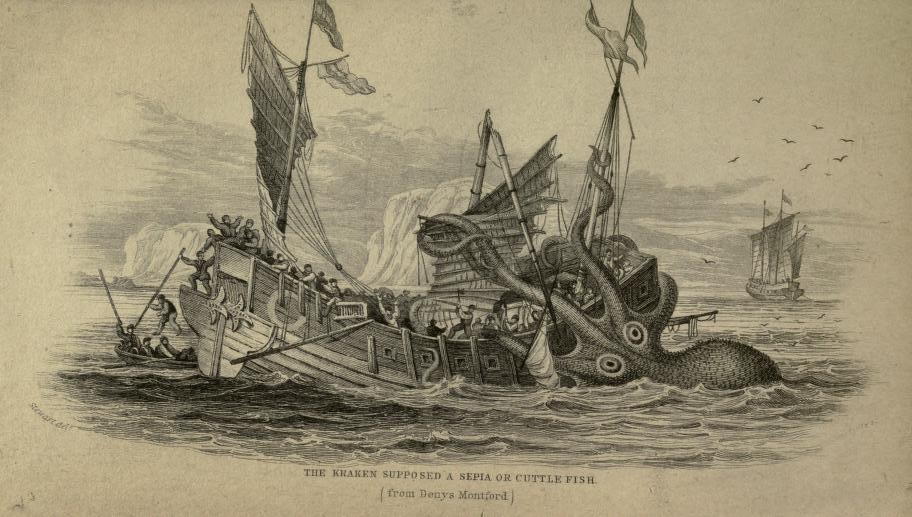
When I say kraken, you probably picture a giant octopus wrapping its arms around a ship, and that image is not useless, because it belongs to the later life of the monster, but it is not where the kraken is most interesting.
The older kraken is stranger than that, because it is not simply a sea beast that attacks from outside the ship; it is a creature so huge and so hidden that sailors or fishermen may mistake part of it for an island, a shoal, a fishing bank, or some other piece of the sea that can be trusted.
That is the first thing you should hold onto: the kraken is not only dangerous because it is enormous, but because it changes the meaning of the surface, so the water seems calm, the fish gather, the catch looks promising, the depth shifts in a way that does not immediately make sense, and only after people have already entered the creature’s zone do they realize that what looked like opportunity may have been the edge of a mouth.
So before we make the kraken into a symbol, or a psychological image, or a modern fantasy monster with tentacles smashing ships, it is worth sitting with the old folklore on its own terms, because the lore already contains most of the meaning.
The northern sea that made the kraken possible
The kraken belongs to the North Atlantic imagination, where the sea was not an abstract blue space but a working world full of weather, darkness, currents, fish, whales, fog, wrecks, floating remains, sudden depth changes, and stories carried by people who had to trust water they could not fully see into.
In that kind of world, a sea monster was not only entertainment, but a way of talking about danger that could not be neatly separated into one cause, because a sailor might fear storm, hunger, broken equipment, bad navigation, deep water, unknown animals, unreliable maps, and the simple fact that the ocean could hide almost anything below a surface that looked ordinary from above.
That is why old sea monsters so often appear on maps, in sailors’ reports, in travel writing, and in natural histories, because they gather several kinds of uncertainty into one visible form.
The kraken is one of the strongest examples of that habit, because it does not just live in unknown water; it almost is unknown water given a body.
The hafgufa: the older creature behind the kraken
One of the most important early relatives of the kraken is the hafgufa, a creature described in the medieval Norwegian text The King’s Mirror, which was written around the middle of the thirteenth century and includes a discussion of strange beings in the northern seas.
In the 1917 English translation, the creature is called the “kraken,” but the older name usually discussed by scholars is hafgufa, and the description matters more than the label because it gives us the basic pattern that later kraken lore keeps repeating.
The creature is said to be so enormous that when it appears, it looks more like an island than a fish, and it is not described mainly as a hunter that chases prey across the sea, but as a being that feeds by opening a huge mouth and bringing up matter that attracts fish toward it.
That is a very old and very sharp idea, because the monster does not need to run after anything when it can make the world come to it, and this already makes the hafgufa more unsettling than a normal predator.
If you want the old kraken in its simplest form, you can think of it like this:
- It stays mostly below the surface.
- It is so large that people cannot easily understand what they are seeing.
- It can be mistaken for land or a fishing place.
- It attracts life toward itself.
- It becomes fully dangerous only after people have already trusted the scene.
This is why the hafgufa matters so much, because it shows that the deepest kraken story was never just “large animal attacks ship,” but something closer to: “the sea offered something, and then the offer turned out to have teeth.”
Egede’s kraken: the calm sea and the false bank
Hans Egede, the Danish-Norwegian missionary who wrote about Greenland in the eighteenth century, connects the Norwegian kraken with the Icelandic hafgufa, and his account keeps the same basic structure: the creature is vast, it is linked with rich fishing, and it can be mistaken for a bank or ground under the water.
The most important part, to me, is that Egede says the creature is often seen in calm weather, and that detail cuts against the usual modern picture of a sea monster appearing in a storm, with lightning, panic, snapping masts, and waves like cliffs, because Egede’s kraken can appear when the sea is quiet and the fishermen think they understand what is happening.
The danger is not announced as danger, because it arrives as abundance.
Fish gather over the creature, the place seems useful, and the fishermen are pulled toward it not because they are reckless fools but because the situation looks like exactly the kind of thing a fisherman would want to find.
Egede also preserves a strange motif where fishermen can save themselves, if they realize what they have encountered, by calling the creature by its name.
That may sound like a small piece of folklore logic, but it is worth remembering, because it means the old story is not only about strength; it is also about recognition, where the person in danger survives not by killing the monster but by knowing what it is.
Pontoppidan turns folklore into natural history
The kraken becomes more famous through Erik Pontoppidan, the bishop of Bergen, who published The Natural History of Norway in the eighteenth century and treated the creature seriously enough to place it inside a work of natural history.
Pontoppidan gives several names for it, including Kraken, Kraxen, Krabben, Horven, Soe-horven, and Anker-trold, and the description he records is one of the main reasons the kraken became such a lasting figure in European imagination.
In his account, fishermen sometimes find the water growing unexpectedly shallow, and their hooks come up full of cod and ling, which tells them that something enormous below them is rising toward the surface, though at first this is useful because the fishing is good and the sea is giving them exactly what they want.
But when the water keeps shallowing, the fishermen know they must row away, because the thing under them is not a bank, or not merely a bank, but the body of the kraken coming up from below.
Pontoppidan describes the creature’s back appearing like a group of small islands, with fish jumping around it, seaweed-like matter or muddy discharge near it, and horn-like or arm-like parts rising from the water as high as the masts of medium-sized ships.
Then comes the part that turns the whole scene from marvel to threat: when the kraken sinks again, it creates a dangerous swell and an eddy or whirlpool that can pull things down with it.
This matters because the kraken does not even have to behave like a normal predator to become deadly; its body changes the sea around it, its rising changes the depth, its feeding changes the movement of fish, and its sinking changes the surface into a downward pull.
That is a much older and more unsettling monster than the movie version, because it is not just a creature inside the ocean, but a creature that makes the ocean itself behave differently.
The false island is the heart of the lore
If you read across the older material, the detail that keeps returning is not tentacles but false stability.
The kraken or hafgufa looks like an island, or like ground, or like a bank, or like a place where fish gather, and that means the monster does not begin as a visible enemy but as something the human mind misclassifies.
That is why the false island is more important than the tentacles, because tentacles are dramatic and they make for good art, but the false island tells you what the kraken really does in the imagination: it makes people doubt the difference between support and danger.
Land is supposed to be the opposite of the sea, because land means rest, orientation, boundary, shelter, and a place where the body no longer has to negotiate every movement with water.
So when a sea monster looks like land, the story is not merely saying that the creature is large; it is saying that even the symbol of safety can be swallowed back into the sea.
That is a colder idea than a ship being attacked by a beast, because it makes the problem not just strength but trust.
How the kraken became a tentacled monster
The tentacled kraken most people know now comes later, through natural history, art, poetry, and eventually popular culture, and older writers were not always consistent about what kind of animal the kraken was supposed to be, because they compared it to different marine forms, including whale-like beings, crabs, starfish, polyps, squid, octopuses, and island-like masses.
That uncertainty makes sense, because the kraken was not originally a clean biological category, but a place where several sea fears collected.
The image gradually moved toward giant squid and giant octopus because those animals gave the myth a body that seemed both monstrous and plausible, especially once European readers had more reports of large cephalopods, strange tentacles, enormous beaks, and deep-sea animals that rarely appeared whole at the surface.
Pierre Denys de Montfort’s famous early nineteenth-century image of a colossal octopus attacking a ship helped fix the ship-destroying tentacled kraken in the visual imagination, while Alfred Tennyson’s poem “The Kraken” helped give the creature a different kind of power, not only as a sailor’s fear but as an ancient sleeper in the deep.
That is why the modern image is not exactly wrong, but it is incomplete, because the tentacles are the visible drama while the older kraken is the unseen situation that made the drama possible.
Was there a real animal behind the myth?
There probably was no single real animal behind the whole kraken tradition, and I would not trust any explanation that tries to reduce the myth too neatly, because sea monsters usually grow out of many things at once: real animals, bad sightings, exaggerated reports, older stories, symbolic needs, dangerous weather, and the simple human habit of giving a face to what cannot be controlled.
Giant squid are still relevant, because they are real, deep-sea animals that can become enormous by ordinary standards, and the Smithsonian notes that the largest scientifically recorded giant squid reached almost 43 feet, or about 13 meters, which is not island-sized, of course, but still large enough to show why tentacles, dead remains, rare sightings, and half-understood deep-sea animals could feed the later kraken image.
Whales may matter even more for the oldest hafgufa material, because recent scholarship has connected the medieval description with whale feeding behaviors called trap-feeding or tread-water feeding, where whales remain near the surface with their mouths open while fish gather or move into danger.
That connection is interesting because it fits the old pattern better than the ship-smashing octopus does: a huge sea creature waits, the mouth is open, fish gather, and what looks like a feeding opportunity from one point of view is death from another.
So if you want the realistic core, I would say this: the kraken probably comes from a long mixing of whale behavior, squid lore, dangerous northern waters, sailor testimony, map imagination, and the feeling that the sea could hide something far larger than the human mind wanted to admit.
Why sailors needed this kind of monster
It is easy to laugh at sea monsters from a modern distance, but that is usually too simple, because old sailors and mapmakers were not merely stupid people inventing cartoon creatures because they lacked science; they were people trying to work, travel, trade, fish, and survive in places where the limits of knowledge were physical, immediate, and sometimes fatal.
If a map had a monster in the water, or a natural history included a huge uncertain creature, or a fishing tradition warned people about something rising under a rich patch of sea, those things could carry real information even when the literal zoology was wrong.
The monster said: this place is uncertain, this water has a memory of danger, this depth is not fully known, this abundance may not be safe, and this boundary between what we know and what we fear has not been settled.
That is why the kraken stayed alive across folklore, natural history, illustration, poetry, fantasy, and film, because it gave people a way to talk about the sea as a living uncertainty, not merely as a blank surface.
Now the psychological reading makes sense
Only after the lore is clear would I move into the symbolic reading, because if we start with psychology too quickly, the kraken becomes an example of an idea instead of a creature with its own history.
But once you have the old image in mind, the psychological meaning is hard to avoid, because in Jungian terms the shadow is the part of the personality that ego-consciousness does not know or cannot yet admit, and the sea is often treated in symbolic language as an image of the unconscious, not because every old sailor story secretly means that, but because depth, darkness, concealment, movement, and hidden life are natural ways to picture what lies below ordinary awareness.
The kraken fits that symbolic language almost too well, because it is mostly unseen, changes the surface before it is fully recognized, appears as something else, attracts before it threatens, remains connected with abundance as much as destruction, and becomes dangerous when people mistake partial signs for the whole truth.
That is exactly why the kraken works as a shadow symbol, because the frightening thing is not only that something dark exists inside or beneath us, but that we may have already built parts of our life around it without knowing what it is.
The kraken as the thing you mistake for ground
The most useful symbolic reading is not “the kraken equals evil,” because that is too flat.
The kraken is more like the buried force that feeds you and threatens you at the same time, which is why the old fishing details matter so much.
People do not move toward the kraken only because they are foolish; they move toward it because the fish are there.
That is a better image of shadow material than a simple monster in the dark, because the parts of yourself you avoid are not always useless or purely destructive; they may contain anger you need, desire you fear, creative force you cannot control, grief that would change you, ambition you have moralized against, or an instinct that has been pushed so far down that it comes back in a distorted form.
The kraken is what happens when that buried thing is no longer content to remain below the waterline.
At first, you may experience it as mood, attraction, irritation, obsession, fatigue, fantasy, hunger, resentment, or some repeated pattern you keep explaining away.
Then the depth changes, the surface no longer behaves normally, and you realize you were not dealing with a small passing feeling but with something large underneath the structure of your life.
That is why Egede’s little detail about naming the creature matters so much.
To name the kraken is not to kill it, but it may keep you from being taken by it completely, because the unnamed thing can pose as fate, truth, destiny, or necessity, while the named thing becomes something you can stand in relation to.
What the kraken finally says
The kraken lasts because it is not only a monster of size, but a monster of misrecognition.
It tells you that the sea can look like land, the dangerous thing can arrive as abundance, the hidden body can change the surface before anyone sees it, and what rises from below may be too large to understand all at once.
That is why the old mythology should come first, because the lore is already doing the work, and the psychology only gives us another language for what the folklore has been showing all along: there are forces beneath the surface that can feed us, lure us, support our illusions, and pull us under if we mistake their upper edge for solid ground.
So the simplest way to remember the kraken is this: it is not just the giant tentacled thing in the water, but the hidden depth that looks useful until it moves.
Source notes
- The King’s Mirror, translated by Laurence Marcellus Larson, especially the section on the marvels of the Icelandic seas and the creature translated as “kraken”: Project Gutenberg
- Hans Egede, A Description of Greenland, including the passage linking the Norwegian Kracken with the Icelandic Hafgufa: Project Gutenberg
- Erik Pontoppidan, The Natural History of Norway, especially the eighteenth-century account of the Kraken, Krabben, or Horven: Internet Archive text and Biodiversity Heritage Library record
- John McCarthy, Erin Sebo, and Matthew Firth, “Parallels for cetacean trap feeding and tread-water feeding in the historical record across two millennia”: Marine Mammal Science
- Smithsonian Ocean on giant squid size, rarity, and deep-sea elusiveness: Smithsonian Ocean
- Natural History Museum on sea monsters and Pierre Denys de Montfort’s colossal octopus image: Natural History Museum
- Poetry Foundation on Tennyson’s Poems, Chiefly Lyrical and “The Kraken”: Poetry Foundation
- Library of Congress on sea monsters in maps and unknown spaces: Library of Congress
- International Association for Analytical Psychology on the shadow and collective unconscious: The Shadow and The Collective Unconscious
- Stephen T. Asma on why monsters and category-breaking hybrids are memorable: Nautilus