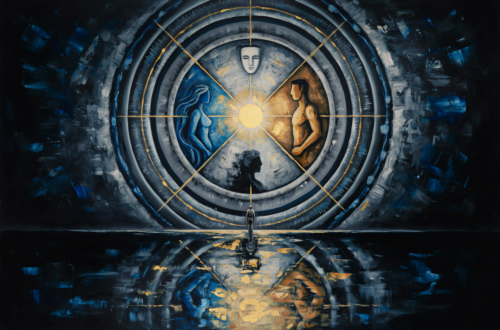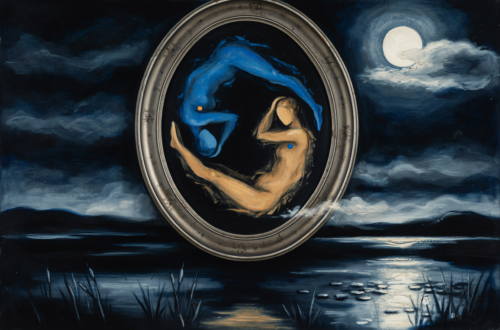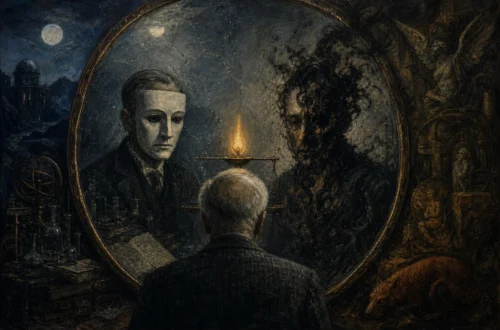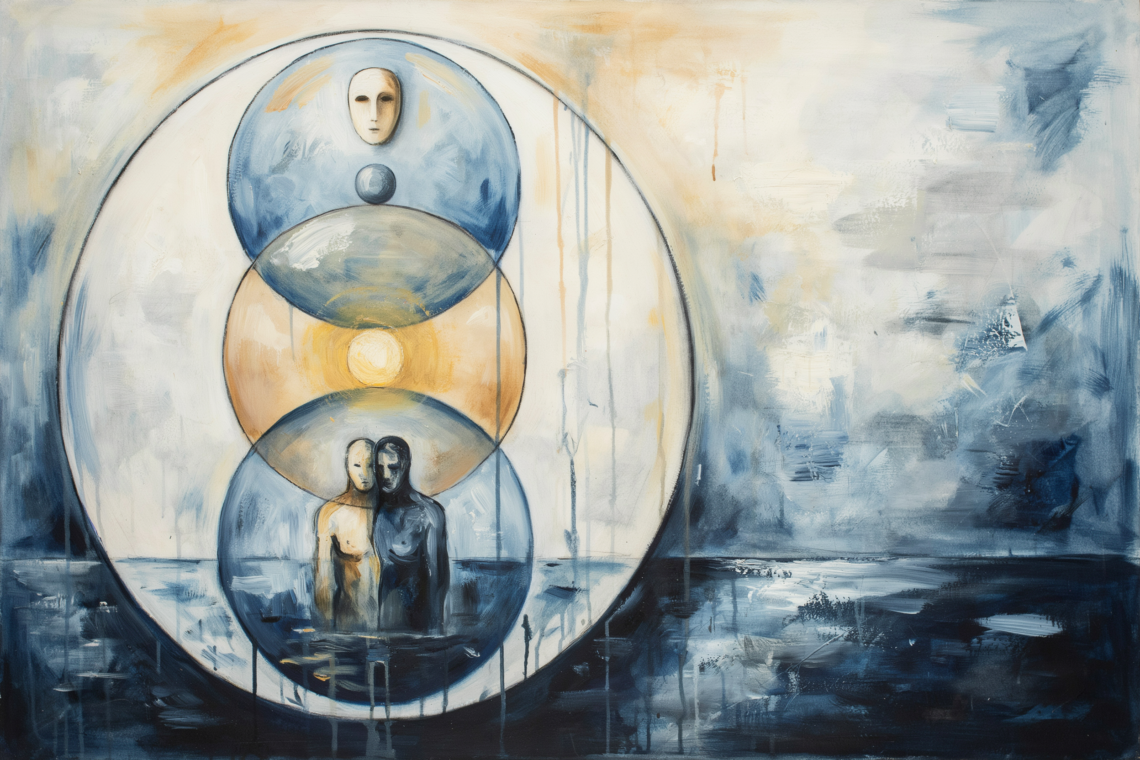
There is a strange experience almost everyone has had. Someone behaves in a way that should be mildly annoying at most, and instead you feel a surge of contempt that surprises you. Or you catch yourself in a flash of cruelty, envy, or pettiness that does not match the person you believe you are. For a moment, a stranger seems to be living inside you.
That stranger has a name. In the work of Carl Jung, it is called the shadow.
The Jungian shadow has become a popular phrase, and like most popular phrases it has been flattened. People use it to mean “trauma,” “the bad version of me,” or “my dark side.” Those readings are not wrong so much as thin. The real concept is more precise, more humane, and far more interesting. It explains why we project, why we overreact, why our best intentions leak something we did not intend, and why becoming a whole person requires us to befriend the part of us we were taught to disown.
The Shadow Is Not the Evil You. It Is the Disowned You.
Here is the correction that changes everything: the shadow is not the worst of you. It is the rejected of you.
To become a recognizable person, a child has to learn what is acceptable. Certain feelings, impulses, and traits get approval. Others get punished, shamed, ignored, or quietly discouraged. The child learns, often without a single conscious thought, which parts of themselves are allowed into the light and which must be hidden to keep love, safety, and belonging.
The accepted parts become the conscious personality. The rejected parts do not vanish. They drop below awareness and keep living there, out of sight. That hidden reservoir is the shadow.
This means the shadow’s contents depend entirely on what you had to reject. For someone raised to be tough and self-sufficient, the shadow may hold tenderness, neediness, and the longing to be cared for. For someone raised to be sweet and accommodating, the shadow may hold anger, ambition, and the capacity to say no. The shadow is not a fixed set of vices. It is whatever was incompatible with the self you were allowed to build.
So if you have been bracing to discover that you are secretly a bad person, relax. The shadow is not a verdict on your character. It is the natural by-product of becoming someone in particular rather than everyone at once.
Why Everyone Has One: The Cost of Becoming a Self
Jung’s insight was structural, not moral. The shadow is not a personal failure. It is the automatic shadow cast by having a defined identity at all.
Think of it this way. Every time you say “this is who I am,” you are also, silently, saying “this is who I am not.” The clearer and brighter your self-image, the sharper the line between what you claim and what you exile. A strong sense of “I am a kind, reasonable, generous person” requires somewhere to put the unkind, unreasonable, ungenerous impulses that every human being feels.
That somewhere is the shadow. And here is the uncomfortable part of the logic: the more polished the self-image, the larger the unlit remainder behind it. People with a perfectly controlled, admirable surface are not people without a shadow. They are often people with a particularly dense one.
This is why the concept is universal. You do not have a shadow because something went wrong. You have a shadow because something went right — you became a person.
The Three-Part Map: Ego, Persona, and Shadow
The Jungian shadow makes far more sense as part of a small system rather than a lone idea. Three terms do most of the work.
- The ego is the center of your conscious identity. It is the “I” that wakes up in the morning, makes decisions, and feels like the headquarters of you.
- The persona is the social face — the version of yourself you present to the world. The word originally meant the mask an actor wore on stage. Your persona is the competent professional, the easygoing friend, the devoted parent. It is necessary and useful. It is also a performance, even when it is sincere.
- The shadow is the disowned remainder — everything that did not fit the ego’s image of itself or the persona’s presentation to others.
These three grow together. The persona and the shadow are especially intertwined: whatever you most need other people to see in you is a strong clue to what you have buried. The face and the hidden remainder are two sides of one coin. A man who needs everyone to experience him as gentle and patient has likely exiled his aggression. A woman who needs to be seen as endlessly capable has likely exiled her own need for help.
When you understand this, the shadow stops being mysterious. To find it, you do not stare into the void. You look at the mask, and then you look behind it.
You Cannot See the Shadow Directly. You Catch It Sideways.
Here is the practical difficulty. You cannot find your shadow by introspecting harder, because the shadow is precisely the material your awareness is organized to exclude. The harder you look straight at it, the more it slips behind you.
Instead, the shadow reveals itself indirectly — in the moments your conscious control loosens. It shows up sideways, through:
- Strong, disproportionate reactions to other people. The trait you “cannot stand,” the kind of person who fills you with contempt.
- Slips and leaks. The sarcastic comment that “just came out,” the behavior you later cannot quite explain to yourself.
- Dreams. Where the disowned parts often appear as figures you can finally see, because the waking ego has stepped aside.
- Patterns you keep repeating despite genuinely intending otherwise.
The skill of shadow awareness is not deeper navel-gazing. It is learning to read your own reactions as information.
Disproportionate Irritation Is the Clearest Signal
Mild disagreement is just disagreement. The reliable signal of shadow material is intensity that does not fit the situation.
When a trait in another person produces contempt, fascination, or a charge far larger than the moment warrants, there is a good chance you are looking at something of your own. The arrogant colleague who enrages you may be carrying the confidence you never allowed yourself. The “selfish” friend who disgusts you may be living the self-priority you were trained to suppress.
This is what Jung called projection — the psyche showing you your own disowned material on the screen of someone else. The other person may genuinely have the trait. That is what makes the hook so convincing. But the size of your reaction belongs to you.
A simple, honest question opens the door: Why does this bother me this much? Not “is this person wrong,” but “why is my charge so large?”
Repression Doesn’t Shrink the Shadow. It Concentrates It.
A natural reaction to all this is to want to suppress the shadow harder — to be even more controlled, even more good. Jung’s observation cuts the other way.
The less the shadow is lived consciously, the denser and more autonomous it becomes. Material that is never acknowledged does not dissolve. It gathers pressure in the dark and acts out crudely when least expected. This is why the most rigidly controlled people sometimes have the most startling eruptions — the sudden rage, the secret life, the self-sabotage that seems to come from nowhere.
The unconscious works by compensation. It tries to balance a one-sided conscious attitude. The more extreme and inflexible the persona, the more counter-pressure builds underneath. A personality stretched too tightly in one direction will eventually be pulled, often involuntarily, toward what it denied.
The shadow is not made safer by being buried deeper. It is made safer by being known.
The Golden Shadow: When You Exile Your Best Qualities
Not everything we disown is dark. This is one of the most overlooked truths about the Jungian shadow, and it reframes the whole idea.
We also bury our gifts. A child whose brightness threatened a parent learns to dim it. A person told they were “too much” learns to make themselves small. Talent, boldness, sensuality, ambition, and creative fire can all be banished as thoroughly as cruelty — and for the same reason: they did not fit the self we were permitted to be. Jungians sometimes call this exiled potential the golden shadow.
You can recognize it by a particular emotion: idealization. When you admire someone so intensely that you feel a little diminished beside them, when a person seems to glow with a quality you long for, you may be looking at your own unlived life reflected back. Hero worship and aching envy are both signals that something valuable of yours is living in someone else.
This is why facing the shadow can feel like both a threat and a homecoming. You go down expecting only monsters, and you also find energy that was always yours — appetite, vitality, the capacity to take up space. The shadow does not just hold what you fear. It holds what you abandoned.
How the Shadow Shows Up in Dreams and Symbols
Because the shadow is hard to see in daylight, it tends to arrive at night as an image. These images repeat across many people, not because every dream means the same thing, but because the psyche keeps staging the same tension. A few patterns are worth knowing.
- The pursuer. A threatening, often faceless figure chasing you. The chase is rarely about destruction. It is the psyche trying to make you turn around. What pursues us is frequently what we are running from in ourselves.
- The unwanted same-sex figure. Jung’s collaborator Marie-Louise von Franz noted that the personal shadow often appears as a figure of the dreamer’s own sex — a despised acquaintance, a “lesser” double, a sibling-like rival. The contempt you feel toward that figure is the revealing detail.
- The intruder. Someone breaking into the house, lurking at the edge of the property, or living in the basement. The house is a familiar image of the self, and its lower or hidden rooms are where disowned material tends to live.
- The dark twin. A figure who looks like you but is somehow wrong, reversed, or sinister — staging the split between your self-image and the self you refuse.
In every case the symbol does the same psychological work. It takes something internal and gives it a face, so that you finally have something to meet. None of these images carries a single fixed meaning. They are invitations to ask what, in you, has been left outside.
What Integration Actually Means
This is where the popular conversation often goes wrong in two opposite directions.
Some people imagine the goal is to defeat the shadow — to finally eliminate the unwanted parts and become purely good. That is not possible, and the attempt only deepens repression.
Others swing the other way and use “I’m owning my shadow” as permission to behave badly — to indulge cruelty or selfishness and call it authenticity. That is not integration. That is just the shadow taking the wheel.
Real integration is a third thing. It means becoming conscious of what you carry, so that you can choose rather than be driven. You do not act out the impulse, and you do not pretend it isn’t there. You acknowledge it, you understand where it came from, and you decide what to do with its energy in the light of day.
Jung put the heart of it plainly: one does not become enlightened by imagining figures of light, but by making the darkness conscious. The aim is not to become luminous and harmless. It is to become whole — to bring more of yourself into your own awareness so that less of you operates behind your back.
This work is the first major step in what Jung called individuation, the lifelong process of becoming who you actually are. The shadow is the first figure you meet on that road. Not the destination, but the threshold.
A Word on the Collective Shadow
The shadow is not only personal. Groups, nations, and cultures have one too. A community that defines itself by certain virtues tends to project its disowned darkness onto outsiders and scapegoats — “we are good, they are the problem.” The mechanism is the same as the individual one, scaled up, and it is worth naming because it shows how high the stakes can be. When a group refuses its own shadow, someone else is usually made to carry it.
Why This Matters
The reason to understand the Jungian shadow is not to label yourself or to go hunting for hidden flaws. It is to stop being quietly governed by a part of you that you cannot see.
The shadow is the disowned self — formed not by failure but by the ordinary cost of becoming a person, revealed sideways through your strongest reactions, made denser by suppression, and holding not only what you fear but much of what you gave up. You will never get rid of it. But you can stop being run by it.
That begins with a turn most people spend their whole lives avoiding. Instead of looking away from the figure in the dark, you turn toward it, and you ask the question that starts the real work: What part of me is this — and what is it trying to bring back?