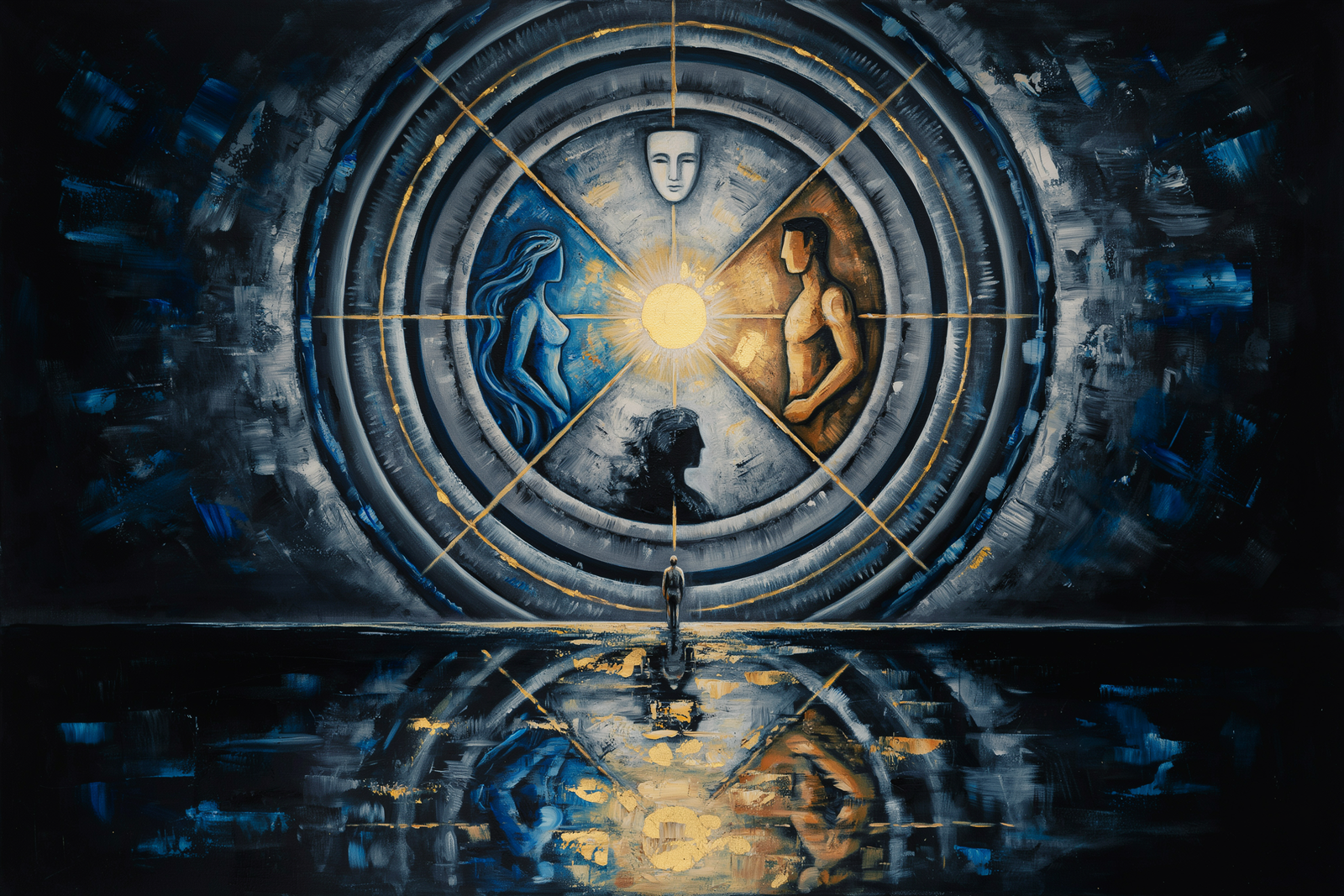
Most people meet the word individuation the way you might meet a stranger at the edge of a party. It sounds important. It carries weight. And it leaves almost no clear impression. You read it in a book about Jung, or hear it on a podcast about shadow work, and something in you leans forward, because it seems to name a thing you have felt without language. A suspicion that the life you assembled, the role you play well, the version of you that everyone recognizes, is not quite the whole story.
That leaning forward is worth trusting. Individuation in Jung's psychology is not academic decoration. It points at a real process, one that tends to begin quietly and then refuse to be ignored. This guide is meant to give you the honest version, the one that does not flatter you and does not promise a tidy transformation, but does take the ache underneath the question seriously.
Simple definition: Individuation is Jung’s term for the lifelong process of becoming psychologically whole by integrating the unconscious parts of yourself, including the persona, shadow, anima or animus, and the Self.
What Jung Actually Meant by Individuation
Carl Jung used the word individuation to describe the process of becoming a single, distinct, indivisible person. The root is the same as in the word individual, something that cannot be divided further without losing what it is. For Jung, this meant becoming psychologically whole, gathering the scattered and divided parts of yourself into a more complete and genuine personality.
The crucial detail, the one that almost every casual summary gets wrong, is that individuation is about wholeness rather than improvement. It is not the project of becoming your best self. It is the slower and stranger work of becoming your complete self, which includes the material you would rather not claim. Modern culture tends to read any inner journey as optimization, a steady upgrade toward a cleaner, more impressive version of you. Jung was after something almost opposite. He believed a person becomes more fully themselves not by polishing away their rough edges but by integrating them.
This is why the title of this article carries a quiet risk. Becoming the self you were meant to be sounds like destiny, like a brighter you waiting to be unlocked. Jung's meaning is rougher and more humbling. The self you were meant to be already contains your fear, your greed, your envy, your unlived desires, the instincts you learned to sit on. Wholeness is not a reward for good behavior. It is an honest accounting.
Individuation Is Not Individualism
Because the word sounds like individualism, people often assume Jung was describing a retreat into the private self, a kind of refined self-absorption where you become more special and less concerned with everyone else. He meant the reverse. Individuation does not pull you out of relationship. It tends to deepen it.
The reason is subtle. As you take back the parts of yourself you have been projecting onto other people, your envy, your judgment, your idealization, you start to see others a little more as they actually are rather than as screens for your own disowned material. A person who has done some of this work is usually less, not more, entangled in the people around them. They are present without needing the other to carry something for them. That is closer to genuine connection than the performance of it.
You Do Not Manufacture It, You Cooperate With It
Here is where the reader's most natural question, how do I do this, needs gentle correcting. Individuation is not primarily something you engineer. Jung observed that the psyche seems to carry its own tendency toward wholeness, the way a seed carries the form of the plant it will become. Something in you is already moving in this direction. The work of the conscious mind, the ego, is less to drive the process and more to notice it, cooperate with it, and stop sabotaging it.
This reframes the anxiety hidden in the question. Many people approach inner work the way they approach everything else, as a goal to be hit through effort and willpower. But you cannot force wholeness through discipline alone, because the parts of you that need integrating live outside your conscious control. They surface in moods, dreams, slips, attractions, and the things that reliably get under your skin. Your job is to pay attention to that material when it arrives instead of managing it away.
This is also why individuation so often begins as a problem rather than a triumph. People expect the start of a meaningful inner journey to feel like clarity or inspiration. More often it feels like restlessness, a dead end, a recurring dream that will not let go, a success that arrived on schedule and left you strangely empty. The crisis is frequently the opening. Something in you is refusing the arrangement you made, and that refusal, uncomfortable as it is, is the process beginning to speak.
The Persona Stops Fitting
The first real movement in Jungian individuation usually involves the persona, the social face you present to the world. The persona is not a flaw. It is necessary. It lets you function in a job, a family, a culture, and it would be foolish to walk around without one. The trouble starts when you forget it is a mask and begin to believe it is the whole of who you are.
For most of us this happens slowly and invisibly. You become the competent one, the reliable one, the easygoing one, the strong one, and the role works so well that it hardens. Then one day it stops fitting. The clothes that used to feel like you start to feel like a costume. You catch yourself performing your own life. This discomfort is often the first sign that something deeper is asking for room.
Jung did not advise tearing the mask off and burning it. That tends to produce chaos, not freedom. The task is subtler, to stop being identical with the persona while still being able to use it. You loosen the grip. You begin to sense a difference between the face you show and the person wearing it. That gap, faint at first, is where individuation gets its first breathing space.
Meeting the Shadow
Once you stop being fully fused with your social face, you tend to run into what Jung called the shadow. The shadow is everything about yourself you have pushed out of the lit room of your self-image. It holds the qualities you find unacceptable, the impulses you were taught to hide, sometimes even strengths and appetites that did not fit the role you committed to.
The shadow is the part of individuation that people quietly skip, because it is not flattering. It is far more pleasant to imagine becoming whole as a process of revealing hidden gold. There is gold in the shadow, that is true, lost vitality and creativity often live there. But there is also pettiness, cruelty, fear, and hunger you would prefer not to own. You usually meet this material first in projection, in the people who irritate you out of all proportion, in the traits you condemn loudest in others. The intensity of the reaction is a clue. Something of yours is hiding inside the thing you cannot stand.
Integrating the shadow does not mean acting on every dark impulse. It means knowing it is there, holding it in consciousness instead of pretending it belongs only to other people. A person who knows their own capacity for cruelty is usually safer, not more dangerous, than a person convinced they have none. This is the moment individuation stops being a comfortable idea and becomes real work.
The Inner Other: Anima and Animus
Deeper in, Jung described an encounter with what he called the anima in men and the animus in women, an inner contrasexual figure that carries the qualities the conscious personality has left underdeveloped. You can take these terms loosely, since the gendered framing reflects Jung's era more than any fixed law. The useful core is this. Somewhere inside you lives a counterpart, an inner other who holds what you have not lived, and you tend to meet it first by falling for it, fearing it, or being haunted by it in dreams and fascinations.
These figures often appear at the threshold between the personal layers of the psyche and something larger. They can mislead and they can guide. Relating to them, rather than being swept away by them, is part of how a personality becomes more complete. For the purposes of this guide it is enough to know they exist, and that the powerful attractions and unsettling figures in your inner life may be carrying more meaning than they first appear to.
The Self and the Ego That Thought It Was in Charge
At the center of Jung's map sits the Self, and it is the heart of why individuation is so easy to misunderstand. We tend to assume that the I we know, the conscious ego, is the center of who we are. Jung proposed that the ego is not the center but a part, and that the true ordering center of the whole psyche, conscious and unconscious together, is the Self. The Self is larger than anything the ego can fully grasp, and it is partly unconscious, which means you can never completely know it.
This is where becoming yourself takes its most surprising turn. The reader who comes to individuation often imagines it as the ego finally getting its way, finally becoming the impressive, fulfilled person it always wanted to be. The actual experience is closer to a demotion. The ego discovers it is not the king of the inner world. It is more like a conscious servant of something deeper, something it did not invent and cannot command. For a personality built on control, this can feel like a small death. It is also the doorway to a more grounded kind of stability.
The analyst Edward Edinger described the lifelong relationship between the ego and the Self as an axis, a living connection that can break in two directions. When the ego inflates, it identifies with the Self and starts to feel chosen, special, beyond ordinary limits. That is grandiosity, and it tends to end badly. When the ego becomes cut off from the Self, the result is the opposite, a hollow, meaningless, disconnected feeling. Healthy individuation keeps the axis intact. The ego stays itself, modest and real, while remaining in conversation with something larger than itself.
The Second Half of Life
If you are reading this with a quiet fear that you have started too late, Jung offers a genuinely consoling idea. He saw the first half of life as legitimately devoted to building the ego and the outer world, finding work, forming relationships, establishing an identity, constructing a strong and functional persona. That phase is not a mistake to be ashamed of. It is the necessary foundation.
The turn toward individuation, the deeper reckoning with shadow, meaning, and the Self, often arrives in the second half of life, and frequently announces itself through exactly the kind of midlife flatness so many people feel. The restlessness you might be carrying is not proof that you fell behind. In Jung's view it can be the psyche signaling that one chapter has done its job and another is asking to begin. Individuation does not run on a schedule you missed. It runs on readiness.
What Individuation Asks of You
So what does this mean practically, without collapsing into a checklist that betrays the whole idea. It means taking your inner life seriously as a source of information. It means noticing your projections instead of believing them, treating your strong reactions as messages, and giving your dreams and recurring images more than a passing glance. It means letting the persona loosen without letting your life fall apart, and meeting your shadow with honesty rather than horror.
Mostly it means a change in posture. You stop trying to force yourself into a finished, perfected shape, and you start cooperating with the slow movement toward wholeness that was already underway in you. Jung's own life suggests this is not a clean ascent. His years of confrontation with the unconscious were disorienting and at times frightening, and what came out the other side was not a man who had solved himself but a man who had become more fully and honestly the person he was.
That is the quiet promise inside individuation jung readers keep circling back to. Not a better you, polished and impressive. A truer you, larger and more real, with the lights on in rooms you used to keep dark. The self you were meant to be is not waiting somewhere ahead of you, perfect and complete. It is being assembled, piece by reclaimed piece, out of everything you already are.