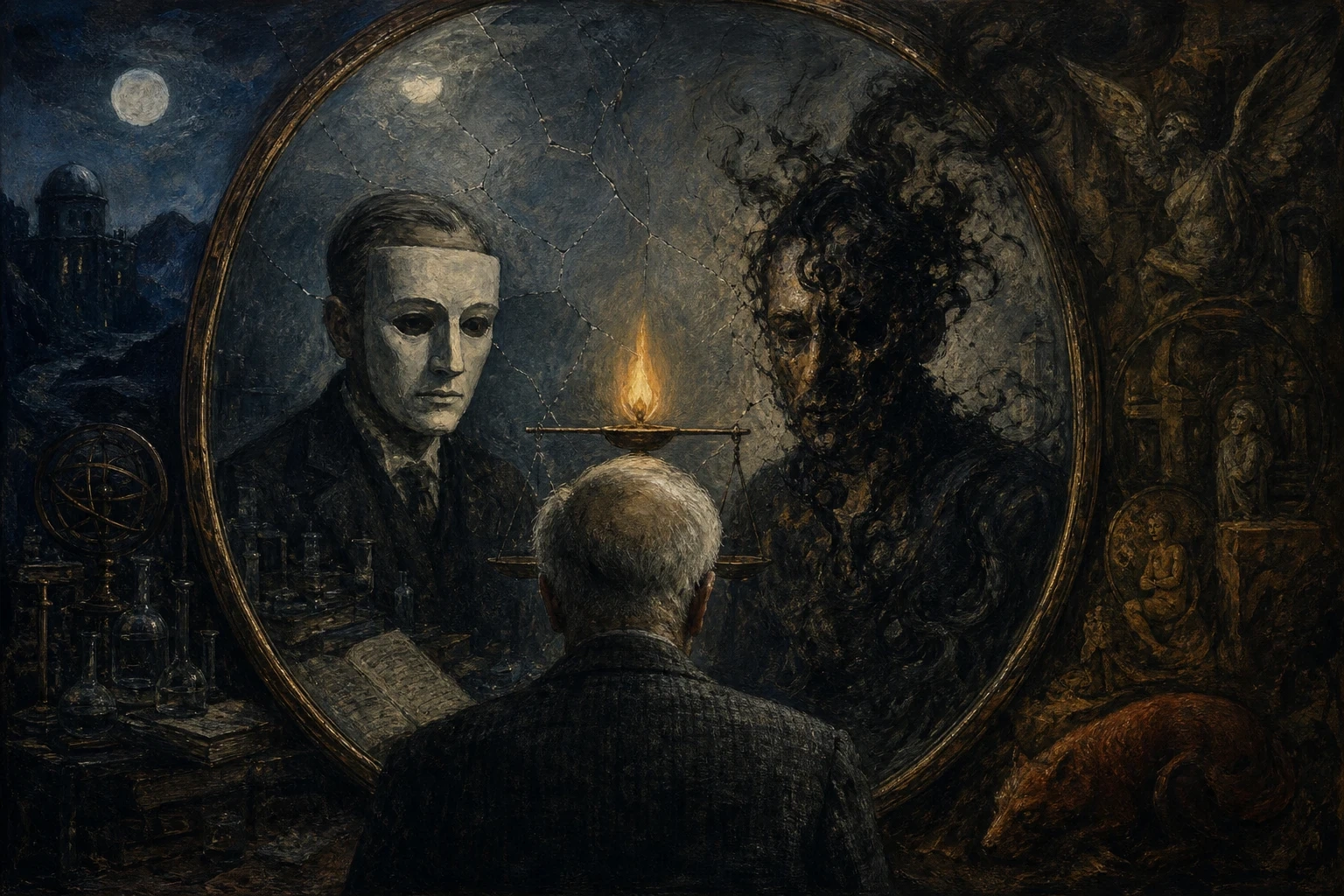
Was Carl Jung a quack? If the question is whether Jungian psychology is scientific in the modern sense, much of it is not. Its central theories are difficult to test, its interpretations can become impossible to disprove, and its clinical evidence is limited.
But that does not make the whole system empty. Jung gave people unusually durable language for shadow, persona, projection, dreams, and the problem of becoming a whole person. The real argument is whether those ideas produce psychological knowledge or only persuasive interpretations.
That question is harder than either "quack" or "genius," and much more worth answering.
Is Jungian Psychology Scientific?
Some Jungian claims are scientific in principle. Whether therapy improves symptoms, whether personality traits remain stable, and whether particular interventions help can all be studied. Other claims, especially strong versions of the collective unconscious and synchronicity, are far harder to test.
The deepest criticism is unfalsifiability: Jungian theory can become so flexible that it cannot be caught being wrong. Karl Popper made this charge against psychoanalysis broadly. Every behavior, dream, and objection can be folded back into the framework. A patient who accepts an interpretation confirms it. A patient who rejects it shows resistance. A theory that explains every possible response risks explaining nothing with precision.
That is the serious case against Jungian psychology. Its greatest strength and greatest weakness come from the same place: interpretation.
Two Ways to Know a Person
To understand the criticism fairly, we need a distinction that almost no one teaches outside of graduate philosophy of science.
There are two broad scales at which psychology tries to understand a human being.
The first is nomothetic knowledge. It comes from groups. You gather many people, measure them, compare them, run statistics, and look for patterns that hold across cases. This is how we learn that a particular medication reduces depression for a meaningful percentage of patients, or that certain personality traits predict certain life outcomes. Nomothetic knowledge is excellent at separating signal from noise. It is what most people mean by "scientific."
The second is idiographic knowledge. It comes from the single case. One person, one biography, one dream, one specific shape of suffering. This is what therapy actually does in the consulting room. It is also what literature does, what a long honest conversation does, what a useful journal entry does. Idiographic knowledge is excellent at meaning. It is terrible at proving itself against an alternative reading.
Both are real. Both have shadows.
The shadow of nomothetic knowledge is the temptation to dismiss whatever it cannot measure. If your study cannot operationalize the meaning of a particular person's recurring dream about a flooded basement, the dream gets coded as noise. The unmeasured becomes the unreal.
The shadow of idiographic knowledge is the temptation to mistake resonance for proof. An interpretation that moves a person can feel undeniably true. Feeling true is not the same as being accurate. A different interpretation, equally moving, might have served just as well.
Jungian clinical work leans heavily toward the idiographic side, but Jung's larger theory often makes sweeping universal claims about humanity. He interpreted individuals case by case while proposing archetypes shared by the species. That tension is central: the method is personal, but the theory is often universal.
Jung Made Three Different Kinds of Claims
One reason the debate about Jung becomes so muddled is that his work is treated as a single object. It isn't. Jung made at least three very different kinds of claims, and they need to be judged by three different standards.
Layer One: Empirical claims
These are claims that can in principle be tested. Does Jungian psychotherapy reduce symptoms? Does it improve interpersonal functioning? Are there stable personality dimensions of the kind Jung sketched in Psychological Types?
Here Jung's work has to compete with everyone else's. The evidence is real, but it is mixed and incomplete (more on that below). This is the layer where the question "does it work" actually has a meaningful answer.
Layer Two: Clinical heuristics
These are the ideas most readers of this site come for. Shadow. Persona. Projection. The compensatory function of dreams. The pull of certain images.
These are often used as interpretive tools rather than literal causal theories. You judge them partly by whether they help a person make sense of something that was previously formless. Does naming a projection change a destructive relationship pattern? Does the language of the persona help someone distinguish who they are from who they perform?
The concepts themselves do not require randomized trials, but their clinical use is still open to study. Their value should remain provisional: useful when they clarify experience, disposable when they merely decorate it.
Layer Three: Metaphysical claims
This is where Jung is most often defended too vigorously by his admirers and dismissed too quickly by his critics. The strong version of the collective unconscious, as an actual psychic stratum shared across humanity and structured by inherited archetypal patterns, is a metaphysical claim. So is synchronicity as a causal principle linking psyche and matter. So is much of what he wrote about alchemy as a real symbolic process unfolding in the world.
These claims are not established science, and pretending they are does Jung no favors. They are speculative metaphysics that arose from a serious mind taking inner experience seriously. They can be interesting to think with. They cannot be cited as findings.
A reader can find shadow work transformative without committing to a metaphysics of the collective unconscious. The two layers come apart cleanly once you see them as separate.
The Strongest Case For Jung
Let's make the best version of the pro-Jungian argument, because it deserves to be made well.
Group averages cannot exhaust an individual life. If you tell a depressed thirty-eight-year-old that a particular therapy works for sixty percent of patients in trials, you have told her something useful and also something deeply insufficient. You have not told her why her suffering looks the way it looks. You have not told her what the recurring dream of an empty childhood house has to do with the marriage she is afraid to leave. You have not told her whether the symptoms going down will produce a life that feels like hers.
These questions are not soft. They are central to whether treatment becomes meaningful change or merely tolerable maintenance. Jung's insistence on the primacy of the individual case was not anti-scientific. It was a recognition that human beings are not interchangeable units, and that meaning is not a luxury layer on top of mental health but part of what mental health is.
Jung also anticipated questions that later psychology approached through different theories and methods: how disowned traits return in relationships, how identity reorganizes in midlife, and how symbolic material can carry psychological meaning. That does not validate Jung's explanations wholesale, but it helps explain why the work has remained fertile.
Modern clinical psychology also takes the individual case more seriously than the caricature of evidence-based practice suggests. Idiographic methods, including person-specific time series, single-case experimental designs, and individualized network models, are a respectable and growing area. The 2019 Behavior Therapy primer by Piccirillo and colleagues lays this out clearly. The APA's own definition of evidence-based practice combines research evidence with clinical expertise and the patient's characteristics, culture, and preferences. Jung was not wrong to insist on the individual case. He was often shaky about how to validate his readings of it.
The Strongest Case Against Jung
Now the other side, also stated at full strength.
Individual complexity can become a shield against ever being wrong. The Jungian framework, in the hands of a closed clinician, becomes a system in which every disagreement is reabsorbed.
Consider the structure. A patient who agrees with the interpretation has integrated something. A patient who disagrees is in resistance. A patient who feels nothing is repressing. A patient who feels too much is being flooded by an activated complex. A critic who attacks the theory in print is projecting a disowned part of themselves. The system has no exit. There is no observation that could, even in principle, count against it.
This is the closed circle, and it is the deepest version of the charge against Jung. It is not a charge of fraud. It is a charge of structural unfalsifiability.
To this we have to add several specific weaknesses.
Clinical anecdotes do not establish causes. Jung's case material is rich, but rich material is not the same as comparative evidence. We do not know, from his cases alone, whether his patients improved because of his interpretations, because of the alliance and attention, because of natural remission, or because of something else entirely.
A moving interpretation can be inaccurate. The fact that a dream reading lands does not prove the reading is the correct one. Several different interpretations, drawn from several different traditions, can land equally well. Resonance is not accuracy. This single sentence does more work than most of the critical literature.
Archetypes can flatten cultural difference. When every mother becomes The Mother, when every wise old man becomes The Wise Old Man, real cultural and historical particularity disappears into a universal template. Jung was often more careful about this than his followers, but the risk is real and structural.
Some of Jung's specific claims have aged poorly. The strict pairing of male anima and female animus carries dated assumptions about gender. The cosmic versions of synchronicity drift into territory most working psychologists would not follow him into. His writings about non-European peoples include passages that are uncomfortable for good reasons, not for fashionable ones.
This is a serious bill of indictment. None of it makes Jung a quack. All of it makes him a thinker who has to be read with discipline.
What the Evidence Actually Shows
For the question "does Jungian therapy work," the most useful single source is Christian Roesler's 2013 review in Behavioral Sciences, available through the U.S. National Library of Medicine, which surveyed the empirical studies of Jungian psychotherapy available at that time.
The honest summary in one breath: across naturalistic and pre-post studies, Jungian therapy was associated with meaningful symptom reduction, improved interpersonal functioning, reduced health care utilization, and improvements that held at follow-up. At the time of the review, however, there were no randomized controlled trials of Jungian psychotherapy.
Both halves of that sentence matter.
The first half is more than nothing. Symptom reduction that holds at follow-up, across multiple studies and countries, is a meaningful signal.
The second half is the real evidentiary gap. RCTs are designed to separate treatment effects from time, attention, expectancy, and regression to the mean. Their absence does not mean Jungian therapy fails. It means we cannot say with confidence what is doing the work or how it compares with better-tested alternatives. The fairest description is encouraging but inconclusive.
A separate empirical question hangs around personality. The MBTI, which descends loosely from Jung's Psychological Types, is the most commercially successful personality instrument in history. It is also widely criticized by personality researchers for poor test-retest reliability and weak predictive validity. This is worth saying carefully. Jung's original typology was more tentative and more clinical than the bright dichotomies of the MBTI industry. The instrument and the source are not the same object, and the failures of one do not cleanly indict the other. But anyone using Jungian language about personality should know that the simplified popular version does not hold up well to the standards modern personality science has set.
Where Jung's Specific Ideas Have Aged Badly
A fair article should name these directly rather than smuggle them past the reader.
The strict anima and animus. Jung treated the anima as the unconscious feminine in men and the animus as the unconscious masculine in women, with assumptions about what "feminine" and "masculine" meant that were standard for his time and are not standard now. Many contemporary Jungians treat these figures less as literal gender pairs and more as images of inner otherness or unlived capacities. The older formulation should not be defended unchanged.
Synchronicity as more than coincidence. As a description of the felt experience of meaningful coincidence, this is honest phenomenology. As a metaphysical claim about a non-causal principle of meaningful connection between psyche and matter, it goes well beyond what evidence supports. Use it as a name for an experience, not as a discovered law.
The Red Book. Between 1913 and roughly 1930, Jung conducted an extended self-experiment in confronting his own unconscious imagery, which became the illuminated manuscript published posthumously in 2009 and edited by Sonu Shamdasani. The Red Book is extraordinary material. It is the raw quarry from which much of Jung's later theory was cut. It is not, however, evidence for the existence of the collective unconscious. It is evidence that a serious man took his own symbolic imagination seriously for nearly two decades.
The political and cultural record. Jung's relationship to the Nazified German psychotherapy society in the early 1930s is genuinely controversial and has been argued over by serious historians since. So have some of his writings about non-European peoples. These belong in any honest assessment of the man. They do not, by themselves, settle anything about his clinical concepts, any more than the personal failings of any other founder of a school settle the value of the school's tools. They are part of the picture; they are not the whole frame.
How a Disciplined Jungian Reading Actually Looks
The difference between Jungian work done well and Jungian work done badly comes down to a single posture: holding an interpretation without locking it.
A closed-loop clinician hears a patient describe a flooded basement dream and announces the meaning: this is your unintegrated emotional life, your unprocessed grief, your unconscious feminine threatening to break through. If the patient agrees, the work has begun. If the patient disagrees, the resistance is itself proof.
A disciplined Jungian-oriented therapist treats the same image as a working reading, one among several. They ask the patient what the basement felt like, what the water felt like, what the house in the dream is to them, what has been happening in their life that this image might be metabolizing. They notice whether the reading produces movement. They notice whether the patient's life shifts. They revise when it does not.
Same framework, very different epistemology. The first is the version critics are right to attack. The second is the standard Jungian practice has to meet if it wants to remain intellectually credible.
A reader can apply the same posture to their own inner work. Hold the interpretation lightly. Track whether it helps. Be willing to set it down when it stops earning its place.
The Honest Verdict
Was Carl Jung a quack? The label is too blunt to be useful. Jungian psychology is not established science as a comprehensive theory. It is a mixed body of testable claims with uneven support, clinical ideas that can be useful, and metaphysical claims that cannot be presented as scientific findings.
At its strongest, Jungian psychology gives us disciplined language for meaning, identity, dreams, projection, and inner conflict. It takes the individual case seriously and asks questions that symptom scales do not answer. The evidence for Jungian therapy is encouraging but inconclusive.
At its weakest, interpretation becomes proof, the analyst cannot be wrong, archetypes flatten cultural difference, and metaphysics is sold as psychology.
The practical standard is simple: treat Jungian interpretations as hypotheses, not revelations. Ask whether they clarify experience, change behavior, and survive disagreement. Use stronger evidence-based treatments where outcomes and safety require them.
Resonance is not the same as accuracy. When a reading lands, that is a reason to explore it, not a reason to declare it true. A serious Jungian approach keeps the symbol alive and the interpretation revisable.
That is the version of Jungian psychology worth defending.