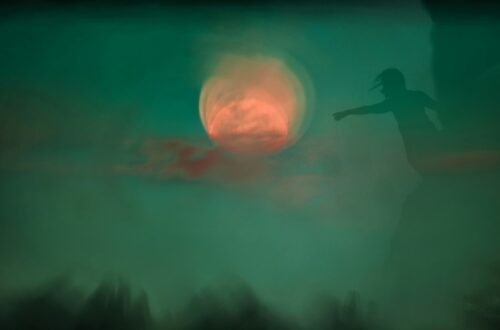
A dark figure in dreams can feel unusually charged. Sometimes it does nothing at all—it simply stands in a hallway, appears at the foot of the bed, watches from a doorway, or follows at a distance—and still the dream leaves a residue of dread after waking.
Part of what makes this image so powerful is that it has presence without identity. The figure is shaped enough to be felt, but not clear enough to be understood. It may have no face, no voice, no recognizable clothing, no known relationship to you. It is someone and something, but not yet anyone in particular.
That ambiguity matters.
In dreams, darkness does not automatically mean evil. More often, darkness means unknown, hidden, unconscious, unintegrated, or not yet visible to the waking mind. The figure may represent fear, shadow material, grief, instinct, intuition, a warning, a protective force, or a guide whose form is frightening because you do not yet know how to relate to it.
The most important question is not simply, “What does the dark figure look like?”
A better question is:
What kind of relationship is the dream asking me to have with this figure?
A dark figure chasing you is not the same dream as a dark figure protecting you. A dark hooded figure blocking a doorway is not the same as a faceless figure silently watching from outside a window. The meaning lives in the behavior, setting, emotional tone, and your response.
A dark figure is often a threshold image: it appears when something unconscious approaches consciousness. Whether that something is fear, shadow, warning, or guidance depends on the dream.
What Does a Dark Figure in a Dream Mean?
A dark figure dream meaning usually centers on something that has not yet been fully recognized. The figure may symbolize an aspect of your inner life that is felt strongly but not clearly named.
Seeing a dark figure in a dream may point to:
- an avoided fear or emotional truth
- repressed anger, grief, desire, or vulnerability
- a disowned part of the self, often called the shadow
- a sense of threat or hypervigilance
- a warning about a real-life pattern you are ignoring
- an inner protector you have not learned to trust
- a guide, guardian, or threshold figure
- sleep paralysis imagery, especially if the dream occurs while waking or unable to move
The dark figure is not defined by its darkness. It is defined by what it does, where it appears, and how you feel in its presence.
For example, being chased by a dark figure in a dream often suggests avoidance. Something is “catching up” with the dreamer: an emotion, memory, decision, conflict, or truth that has been pushed away for too long.
A dream of a dark figure standing in a doorway, however, may be less about pursuit and more about transition. Doorways are liminal spaces. A figure there may symbolize the fear of crossing into a new stage of life, or the need to pause before entering unknown psychological territory.
A dark figure protecting you has a very different tone again. It may represent a fierce inner boundary, an ancestral or spiritual presence, or a part of you that knows how to defend what your conscious personality has been trained to keep pleasant, harmless, or compliant.
So before deciding that the dream is “bad,” notice the drama of the dream itself. Is the figure attacking, waiting, warning, guarding, observing, guiding, or simply present?
That difference is everything.
Why the Figure Appears Dark
Darkness in dreams often represents what consciousness has not yet illuminated.
This does not mean the content is negative. The unconscious is “dark” because it is not fully seen. It may contain fear and pain, yes, but also instinct, creativity, intuition, strength, memory, and undeveloped forms of life.
The psyche gives darkness to what consciousness has not yet learned to see.
A dark figure may appear because the dreamer does not yet have an image, language, or emotional capacity for what the figure carries. The dream creates a silhouette before it creates a face.
Imagine someone who has spent years being agreeable, accommodating, and careful not to upset anyone. They may dream of a tall black figure following them through city streets. On the surface, the dream feels threatening. But psychologically, the figure might be carrying the dreamer’s own anger, assertiveness, or refusal—energies that have been exiled because they felt dangerous to the conscious self-image.
Or imagine someone entering a major life transition: divorce, career change, spiritual crisis, grief, recovery, parenthood, or the end of a long identity. They dream of a dark hooded figure standing at a doorway. The figure does not attack. It simply prevents passage. In this case, the darkness may belong to the unknown future. The dreamer cannot yet see what life will become on the other side.
A third dreamer might see a dark woman standing silently in water. There is no violence, but the image feels solemn. Water often relates to emotion, grief, intuition, or the deeper psyche. The dark woman may represent an emotional knowing the dreamer has not yet allowed into waking awareness.
Darkness, then, is not a verdict. It is a condition of visibility.
The figure may be dark because it is evil. But just as often, it is dark because it is not yet known.
The Jungian Shadow: Is the Dark Figure Part of You?
In Jungian psychology, the shadow is not simply the “bad” side of the personality. Carl Jung used the term to describe those parts of ourselves that the ego does not identify with and often refuses to recognize.
The shadow can include cruelty, envy, rage, selfishness, and destructive impulses. But it can also include tenderness, need, creativity, sensuality, ambition, spiritual longing, grief, intelligence, instinct, and power.
In other words, the shadow is not only what is morally wrong. It is what has been exiled from the conscious personality.
A shadow figure in dream imagery may appear as a dark person, a faceless stranger, a threatening pursuer, a silent watcher, or a powerful figure whose intentions are unclear. The dream gives the shadow a body because the rejected material wants relationship. It wants to be seen, negotiated with, understood, or integrated.
A few examples make this clearer:
A polite, conflict-avoidant person dreams of a frightening dark figure chasing them. The figure may represent repressed anger or the ability to say no. Because the dreamer experiences anger as dangerous, the dream images it as something dangerous.
A highly controlled person dreams of a wild dark figure moving through a forest. The figure may symbolize instinct, spontaneity, sexuality, or body wisdom—energies that do not obey the dreamer’s usual need for order.
A person committed to being “spiritual” in a purely light, kind, elevated way dreams of a sinister dark presence. The dream may be exposing rejected doubt, envy, hunger, resentment, or power. Not to shame the dreamer, but to restore wholeness.
A grieving person dreams of a silent black figure sitting beside them. It may not be a threat at all. It may be grief itself, present but not yet spoken.
The shadow figure is often terrifying in proportion to how much psychic energy has been spent keeping it outside the self-image.
This is why shadow dreams can feel so intense. The figure is not only frightening because of what it represents. It is frightening because it carries life energy that has been split off. What has been banished often returns first as a threat.
But shadow work does not mean assuming every dark figure is “really you” in a simplistic way. Some dream figures may represent other people, collective fears, inherited family patterns, trauma responses, or spiritual archetypes. Still, it is often useful to ask:
If this figure were carrying a part of me, what part would I least want it to be?
The answer may reveal more than the dream dictionary ever could.
When the Dark Figure Represents Fear or Anxiety
A scary dark figure in dream imagery can also arise when the nervous system is carrying fear without a clear object.
Anxiety often feels vague in waking life. You may know something is wrong, but not what. You may be tense, watchful, irritable, or uneasy without being able to identify the source. Dreams are very good at condensing diffuse emotional states into vivid images.
A dark figure may be the dream’s way of saying: Here. This is what the fear feels like.
Different behaviors suggest different psychological patterns:
- A dark figure chasing you may symbolize avoidance, pressure, or an emotion gaining force because it has been delayed.
- A dark figure standing silently may point to dread, anticipation, or the feeling that something unspoken is present.
- A dark figure watching you may relate to shame, self-consciousness, hypervigilance, or an internalized critic.
- A dark figure attacking you may reflect emotional overwhelm, panic, intrusive memory, or a fear of losing control.
- A dark figure blocking your path may symbolize resistance, prohibition, or a life transition you are not ready to enter unconsciously.
A dream of being watched by a dark figure, for example, can be especially unsettling. It may connect to the feeling of being judged, exposed, monitored, or silently evaluated. But the watcher is not always external. Sometimes it is the part of the psyche that knows what the waking self is trying not to know.
Someone tolerating betrayal in a relationship might dream of a black silhouette standing in the kitchen. The dreamer feels afraid, but the figure does nothing. In such a dream, the figure may not be evil. It may be an inner witness: the part of the self that refuses to keep pretending everything is fine.
A dark figure may appear when the nervous system knows something before the conscious mind has language for it.
This does not mean every frightening dream is a hidden trauma memory or literal warning. It does mean that fear in dreams deserves attention. Fear can signal danger, but it can also signal proximity to change.
The ego often experiences the unknown as threat before it experiences it as meaning.
Is the Dark Figure Evil?
It is understandable to wonder whether an evil figure in dream meaning applies when the figure feels menacing, predatory, or inhuman. Some dreams do carry a sense of moral danger. They may point toward manipulation, addiction, self-betrayal, destructive habits, abusive relationships, or situations where something in you knows a boundary has been violated.
But darkness alone does not prove evil.
Dreams use frightening images to communicate urgency. They speak in emotional intensity, not polite explanation. Something may look terrifying because your psyche needs you to pay attention, not because the image is malicious.
A more careful approach is to ask what kind of presence the figure has. Does it feel:
- predatory or hungry?
- neutral but powerful?
- familiar beneath the fear?
- grieving or burdened?
- authoritative or ritual-like?
- protective?
- mechanical or empty?
- human but hidden?
- sacred, solemn, or ancient?
- invasive and parasitic?
- like a part of you, or distinctly other?
These nuances matter.
If the figure feels predatory and the dream contains themes of violation, coercion, manipulation, or entrapment, it may be worth asking where in waking life you feel your boundaries are being crossed. The dream may be dramatizing a real pattern.
If the figure feels severe but not cruel, especially if it appears at a doorway, staircase, bridge, forest edge, cave, graveyard, church, temple, or shoreline, it may be functioning more like a threshold guardian than an enemy.
If the figure feels familiar but frightening, it may be shadow material: something that belongs to you but has not yet been welcomed into conscious life.
In dreams, “evil” is sometimes a moral reality—but just as often, it is the name we give to psychic material we are not ready to meet.
The key is discernment, not denial and not paranoia.
When the Dark Figure Is a Guide
Some dark figures are not chasing the dreamer. They are waiting.
They appear in liminal places: doorways, hallways, staircases, bridges, forests, caves, bedrooms, shorelines, graveyards, churches, temples, or at the edge of water. These are symbolic thresholds—places where one state of being gives way to another.
A dark presence in dream meaning may sometimes relate to a guide, guardian, ancestor image, or initiatory figure. In myth and depth psychology, the guide does not always appear comforting. Guides often disturb the ego because they lead us away from familiar identity.
A threshold guardian dream may occur when you are approaching a major shift: ending a relationship, entering therapy, confronting family history, changing vocation, beginning serious spiritual practice, grieving a death, recovering from addiction, or allowing a truth you have avoided to become conscious.
The guardian may block the way not as punishment, but as a demand for awareness.
The first form of guidance is sometimes obstruction.
Consider a dream in which you want to rush through a door, but a dark hooded figure stands before it. The figure does not speak or attack. You feel you cannot pass. A shallow interpretation might say, “Something bad is blocking you.” But symbolically, the dream may be more subtle: you are approaching a threshold, and some part of you knows you cannot cross it in your old unconscious way.
The figure may be asking:
- Are you ready?
- Do you understand what this change will cost?
- What are you trying to avoid by rushing forward?
- What must be honored before you enter the next room?
A guide can appear dark because the next stage of life has no face yet. It has not become familiar. You are being asked to relate to the unknown before it becomes reassuring.
Not every dark guide is spiritual in a literal sense. It may be an archetypal image from the psyche. It may be an inner authority, an ancestral pattern, a severe protector, or a symbol of death and rebirth. The point is not to label it too quickly.
A genuine guide image, even if dark or stern, often leaves behind a strange clarity, sobriety, or sense of summons. A fear-image tends to leave only contraction, obsession, or dread.
That distinction is worth noticing.
Common Dark Figure Dream Scenarios
A Dark Figure Chasing You
Being chased by a dark figure in a dream often suggests avoidance. The figure may represent an emotion, truth, memory, conflict, decision, or consequence that you have been outrunning.
The question is not only, “What is chasing me?”
It is also:
What happens if I stop running?
For example, a dreamer is chased by a tall dark figure through city streets. The figure never speaks and never shows its face. In waking life, the dreamer has been avoiding a confrontation with a parent or partner. The dark pursuer may represent the confrontation itself, but also the dreamer’s own anger trying to reach consciousness.
Chase dreams often intensify when avoidance has become expensive. The psyche creates pursuit because the avoided material now has momentum.
A Dark Figure Watching You
A dream of a dark figure staring at you may point to shame, exposure, judgment, conscience, or hypervigilance.
If the figure is outside a window, the symbolism becomes even more specific. Windows separate inside from outside while still allowing visibility. A black silhouette standing outside and staring in may suggest something outside your conscious identity trying to be seen. It may also reflect the feeling of being observed by an internalized authority: a parent, culture, religion, community, or harsh self-image.
But a watcher can also be an inner witness. It may be the part of you that sees clearly, even when your waking self has chosen not to.
Ask whether the watching felt invasive, sorrowful, accusing, protective, or simply aware.
A Dark Figure in a Doorway
A dark figure in doorway dream usually carries threshold symbolism. Doorways mark the boundary between one room and another, one identity and another, one stage of life and another.
If the figure blocks the doorway, it may symbolize fear of change, an inner prohibition, unfinished business, or the need for preparation before crossing into something new.
If it invites you through, the dream may be staging an initiation.
If it simply stands there, neither threatening nor welcoming, the image may represent ambiguity itself: you are between known and unknown, and the psyche has given that uncertainty a body.
Doorway dreams are rarely only about the figure. They are also about the passage.
A Dark Figure at the Foot of the Bed
A dark figure at the foot of bed dream can feel intensely personal because the bedroom is a place of vulnerability. Beds relate to rest, intimacy, illness, sexuality, sleep, and the boundary between waking and dreaming.
If you are asleep in the dream and a dark figure stands over or near you, the image may symbolize feeling unsafe in rest, difficulty surrendering control, intimacy fears, or body-based anxiety.
However, if the experience occurs while you are waking or falling asleep, especially if you cannot move, it may be sleep paralysis rather than a conventional dream. Sleep paralysis can include a sensed presence, a dark figure in the room, pressure on the body, fear, and the inability to speak or move.
That does not make the experience meaningless. It simply means the mechanism may be physiological as well as symbolic.
A Faceless Dark Figure
A faceless dark figure dream often points to something unidentified. The psyche is showing a force before it becomes a person.
Facelessness may suggest:
- an unknown aspect of yourself
- a fear you cannot yet name
- projection onto others
- dissociated emotion
- archetypal energy rather than a specific person
- lack of clarity about who or what threatens you
A faceless figure can be frightening precisely because there is no face to negotiate with. No expression, no history, no emotional cue. It is pure presence.
Sometimes, as dreamers become more willing to engage the symbol, the figure changes. It may become human, reveal a face, speak, shrink, age, turn into a child, or become someone recognizable. That transformation often marks a movement from fear to relationship.
A Hooded Dark Figure
A dark hooded figure in dream often carries archetypal weight. Hoods conceal identity, but they also suggest ritual, office, secrecy, authority, death, initiation, or hidden knowledge.
A hooded figure may represent fear of death or change, but not always literal death. More often it points to death-and-rebirth symbolism: the end of a role, illusion, attachment, relationship pattern, or old self-image.
If the hooded figure blocks a path, it may be a threshold guardian. If it leads you somewhere, it may be a guide into unknown material. If it attacks, the dream may be staging your fear of surrendering control.
The hood matters because it makes the figure less personal and more symbolic. It may not be “someone.” It may be a role, force, or function in the dream.
A Dark Figure with Red Eyes
A dark figure with red eyes dream intensifies the sense of threat. Red eyes often suggest alarm, rage, instinct, predatory energy, or danger. The image may connect to animal fear, demonic imagery, anger, desire, or the dreamer’s own sense that something is emotionally overheated.
But red eyes can also show how fear colors perception. The figure may appear more monstrous because the dreamer’s fear is already activated.
Ask what the red seems to carry: rage, warning, hunger, grief, heat, intoxication, or vitality. Red is not only danger. It is also blood, life force, passion, and heat.
A Dark Figure Protecting You
A dark figure protecting me dream complicates the assumption that darkness equals danger.
In some dreams, a threatening person or force appears, and then a dark figure arrives behind the dreamer, frightening the attacker away. The dreamer may be afraid of both figures, yet the dark one functions as a protector.
This can symbolize:
- reclaimed aggression
- boundary energy
- survival intelligence
- an inner protector
- ancestral or guide symbolism
- the shadow as ally
Many people fear their own protective force because it does not look “nice.” If you were trained to be agreeable, self-sacrificing, or nonthreatening, your capacity to defend yourself may first appear in dreams as large, dark, severe, or intimidating.
The dream may be asking you to recognize strength that you have mistaken for danger.
Speaking With a Dark Figure
When a dark figure speaks, the symbol is becoming relational.
This is often a significant shift. The figure is no longer only an object of fear; it has a voice, message, demand, warning, question, or teaching. Even if the words are strange, the dream has moved from pursuit into encounter.
If you remember what the figure said, write it down exactly. Dream speech can be compact, symbolic, and more layered than it first appears.
If you do not remember the words, notice the tone. Was it commanding, gentle, mournful, mocking, protective, formal, intimate, or calm? Tone often carries as much meaning as language.
How to Interpret Your Own Dark Figure Dream
The meaning of a dream about a dark figure depends on context. Instead of forcing an immediate interpretation, stay close to the details.
What Was the Figure Doing?
Begin with behavior.
Was the figure:
- chasing you?
- watching you?
- blocking a path?
- standing still?
- attacking?
- guiding?
- protecting?
- waiting?
- disappearing?
- speaking?
A shadow that chases may be asking for attention. A shadow that blocks may be asking for readiness. A shadow that protects may be asking to be trusted.
Where Did the Figure Appear?
Settings are not background decoration in dreams. They are part of the symbol.
A dark figure in a bedroom may relate to vulnerability, rest, intimacy, or sleep paralysis.
A dark figure in a hallway may suggest an in-between state: not where you were, not yet where you are going.
A figure in a basement may point to buried material, family history, old memory, or unconscious foundations.
A figure in a forest may connect to instinct, the natural psyche, or entering territory beyond social identity.
A figure outside a window may symbolize something outside conscious awareness that is trying to be seen.
A figure near water may relate to emotion, grief, intuition, or the depths of feeling.
A figure on a road may concern life direction.
A figure on stairs may suggest descent, ascent, development, or movement between levels of awareness.
How Did You Feel?
Do not stop at “scared.” Fear has many textures.
Did you feel dread, guilt, fascination, recognition, shame, awe, paralysis, curiosity, grief, forbidden attraction, calm, disgust, reverence, or a sense of being summoned?
The emotion is often the key.
A dark figure that evokes awe is different from one that evokes disgust. A figure that feels familiar is different from one that feels alien. A figure that makes you ashamed may point somewhere different than a figure that makes you alert.
What Changed When You Looked at It?
This is one of the most revealing questions.
When you turned toward the figure, did it grow larger, vanish, speak, become human, remove its hood, attack, soften, disappear into smoke, or remain unchanged?
If the figure becomes less frightening when faced, the dream may be about avoidance and integration.
If it becomes more threatening, the dream may be showing that direct confrontation is not yet the right approach—or that the material needs support, pacing, and containment.
If it vanishes, it may have been sustained by fear or unconsciousness.
If it speaks, the psyche may be inviting dialogue.
What in Your Life Feels Unknown but Powerful Right Now?
Finally, connect the dream to waking life.
The figure may relate to:
- a decision you are delaying
- anger you are suppressing
- grief you are avoiding
- a relationship dynamic you do not want to see
- emerging ambition or power
- spiritual uncertainty
- burnout or self-betrayal
- trauma activation
- family patterns
- a transition you cannot reverse
The dark figure may be the shape of a truth before it has words.
Shadow Work Prompts for a Dark Figure Dream
Shadow work with this kind of dream should be slow and respectful. The goal is not to dominate the figure, banish it, or force yourself to “face your fears” before you are ready.
Instead, approach the image as a relationship.
You might journal with prompts like:
- What do you want me to know?
- What are you protecting?
- What are you preventing me from seeing or doing?
- What part of me do you carry?
- Why do you appear dark?
- What would I see if your face became visible?
- What happens if I stop running?
- What do I lose by keeping you outside me?
- What strength might you contain?
- Do you belong to me, to someone from my past, to my family system, or to something larger and archetypal?
If you practice active imagination or dream re-entry, keep the work grounded. Imagine returning to the scene, but do not force the figure to transform. Let it respond. Notice your body. Notice whether curiosity is available, or whether fear becomes overwhelming.
If the dream feels trauma-linked, do not push. Some images need containment before confrontation. Working with a therapist, dreamworker, or trusted guide can be helpful, especially if the dreams are recurring, destabilizing, or connected to waking panic.
Shadow work does not always make the figure disappear. Sometimes it gives the figure a face.
Dark Figure Dreams and Sleep Paralysis
Some dreams of dark figures overlap with sleep paralysis.
Sleep paralysis often occurs while falling asleep or waking. During an episode, the body remains temporarily immobilized while dream imagery or dream-like perception overlaps with the room. People may sense a presence, see a dark figure standing nearby, feel pressure on the chest, hear sounds, or experience intense fear.
This can feel spiritual, demonic, or paranormal because the experience seems to happen in the actual room while you are conscious but unable to move.
A physiological explanation does not mean the experience is “nothing.” The fear is real. The imagery may still be symbolically meaningful. But recognizing sleep paralysis can reduce terror and prevent the mind from building unnecessary fear around the event.
If these episodes are frequent, extremely distressing, or disrupting your sleep, consider speaking with a medical or mental health professional. Sleep quality, stress, sleep position, irregular schedules, anxiety, and certain sleep disorders can all play a role.
Grounded understanding is not the enemy of meaning. Sometimes it is what allows meaning to be approached without panic.
Spiritual Meaning of a Dark Figure in a Dream
The spiritual meaning of a dark figure in a dream depends on discernment. It is possible, in some traditions and personal experiences, to understand such a figure as a guide, ancestor, guardian, messenger, or threshold presence. It is also possible for the dream to be psychological, symbolic, physiological, or some mixture of these.
The wisest approach is not to rush toward certainty.
A spiritually meaningful dark figure may appear as:
- an unknown guide
- an ancestor or guardian image
- a threshold guardian
- a death-and-rebirth symbol
- a call to spiritual maturity
- a severe but protective presence
- an archetypal messenger
- a confrontation with fear-based projection
But spiritual interpretation should be tested by its fruits.
Does the dream leave you clearer, more honest, more grounded, or more accountable? Does it bring sobriety, protection, or a sense of meaningful summons? Does it encourage you to become more whole?
Or does it leave you trapped in paranoia, obsession, helplessness, or fear dependency?
A guide does not usually make you smaller. Even if the encounter is unsettling, it tends to deepen your relationship with truth. A fear-image, by contrast, often narrows your world and makes you fixate on threat.
This does not mean you should dismiss the spiritual dimension. It means you should hold it with maturity.
Not every dark presence is a spirit. Not every dark presence is “just anxiety.” Dreams often live in the borderlands between psyche, body, memory, and mystery.
Frequently Asked Questions About Dark Figure Dreams
What does it mean to dream of a dark figure?
A dark figure in a dream usually represents something unknown, unconscious, feared, hidden, or not yet integrated. It may be an emotion, shadow aspect, warning, guide, protector, or image of anxiety. The meaning depends on what the figure does, where it appears, and how you feel toward it.
Is a dark figure in a dream a bad omen?
Not necessarily. Darkness alone does not mean evil or bad luck. A dark figure may symbolize fear, transition, shadow material, grief, intuition, or an unknown part of yourself. Some dreams can warn us about real danger or self-betrayal, but the dream must be read in context.
What does it mean if a dark figure is chasing me?
A dark figure chasing you often suggests avoidance. The figure may represent an emotion, truth, memory, conflict, or decision that you are trying not to face. It may also symbolize pressure, panic, or shadow material gaining force because it has been ignored.
What does a faceless dark figure mean in a dream?
A faceless dark figure often points to something unidentified or not yet conscious. It may be an unknown fear, a projection, a dissociated emotion, or an archetypal force rather than a specific person. Facelessness suggests that the psyche can feel the presence of something before it can give it a clear identity.
What does a dark hooded figure mean?
A dark hooded figure may symbolize secrecy, death and rebirth, initiation, hidden knowledge, authority, or fear of the unknown. If it appears at a doorway or threshold, it may function as a guardian. If it guides you, it may represent an inner or spiritual guide. If it attacks, it may reflect fear of surrender, change, or loss of control.
Can a dark figure be a spirit guide?
In some spiritual interpretations, yes. A dark figure can sometimes function as a guide, ancestor image, protector, or threshold guardian. However, it is best to approach this with discernment. A guide-like figure often leaves behind clarity, steadiness, or a sense of meaningful summons, while a fear-image tends to leave only contraction and dread.
Why do I keep dreaming about a dark figure?
Recurring dark figure dreams suggest an unresolved pattern. The psyche may be repeatedly presenting a fear, shadow trait, emotional truth, relationship dynamic, trauma response, or life transition that has not yet been consciously engaged. Recurrence often means the dream is asking for a different relationship to the image.
What if I saw a dark figure while unable to move?
If you saw a dark figure while unable to move, especially while falling asleep or waking, it may have been sleep paralysis. Sleep paralysis can involve a sensed presence, dark figure, pressure, fear, and inability to speak or move. It can still feel deeply meaningful, but the mechanism may be physiological as well as symbolic.
Final Reflection: The Unknown Is Not Always the Enemy
A dark figure in dreams sits at the border between fear and revelation. It may be an image of anxiety, a shadow aspect, a warning, an inner protector, a threshold guardian, or a guide whose face has not yet become visible.
The task is not to label it too quickly.
If you decide immediately that it is evil, you may miss the grief, anger, strength, or guidance it carries. If you dismiss it as “just stress,” you may miss the intelligence of the dream. If you romanticize it as a guide without discernment, you may overlook a real warning or unresolved fear.
Stay close to the dream.
What did the figure do? Where did it stand? What did it make you feel? What changed when you looked at it? What in your waking life feels similarly unknown, powerful, forbidden, or difficult to face?
A dark figure is often a presence before it is a person. It may be the psyche’s way of saying: There is something here. You do not yet know what it is. But it is ready to be noticed.
Not every frightening dream figure is an enemy. Some are guardians wearing the face of what we fear. Some are shadows asking to be integrated. Some are warnings. Some are guides. Some are simply the form our fear takes before it becomes language.
The unknown is not always safe. But it is not always hostile either.
Sometimes the dark figure is not there to harm you.
Sometimes it is there because something in you is finally close enough to be seen.