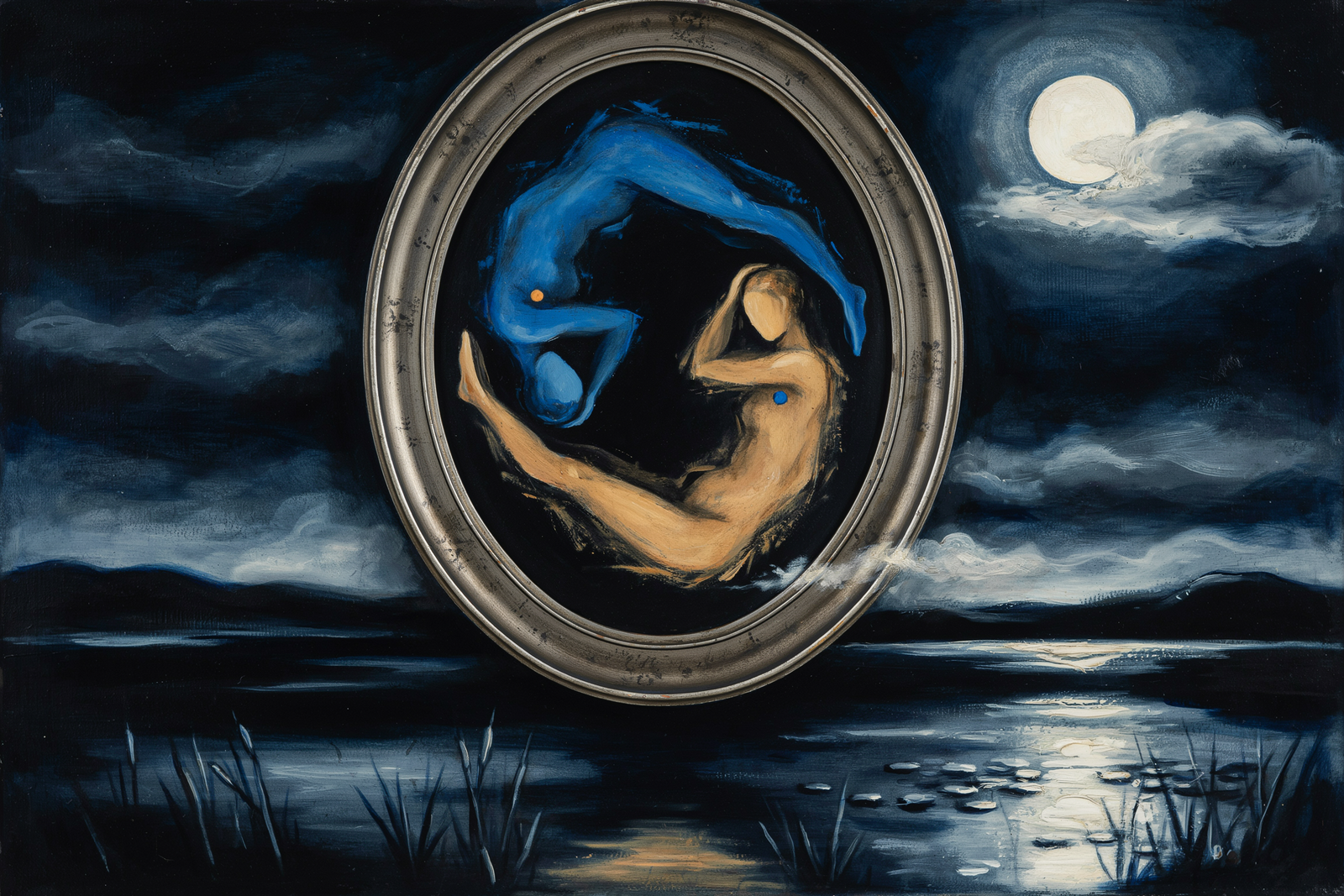
There is a particular kind of fascination that arrives without warning. Someone walks into the room and, before they have said anything worth saying, they matter too much. Or a mood drops over a steady, reasonable person like weather, and they cannot trace where it came from. Or an inner voice delivers a verdict about your worth in a tone so absolute it feels less like a thought and more like a sentence handed down.
Jung had a name for the figure behind these experiences. He called it the anima in men and the animus in women, and he treated it as one of the most consequential discoveries in the inner life. The concept of anima and animus in Jung's work is easy to reduce to a tidy formula, but the formula misses the thing that actually grips people. This is not really an article about inner gender. It is about the disowned other within, and the strange way we keep meeting it in the world outside us.
What Jung Actually Meant by Anima and Animus
Start with the simple version, because it is where most explanations both begin and stop. Jung proposed that the conscious personality tends to identify with one stance. A man, shaped by culture and biology and the mask he wears in the world, identifies with a certain idea of masculinity. The qualities that do not fit that idea do not vanish. They collect in the unconscious and gather around a personified inner figure of the opposite kind. Jung called the man's inner feminine the anima, and the woman's inner masculine the animus. The shared term is the contrasexual archetype, the inner image of the other.
In Aion, Jung described these as a pair, a kind of inner couple he named the syzygy, an old word for two things yoked together. That image matters more than it first appears. The anima and animus rarely show up as a quality you can list on a page. They show up as a relationship, a meeting, an attraction, a quarrel. The psyche stages them as drama because that is how something autonomous announces itself.
And autonomous is the right word. In his Two Essays on Analytical Psychology, Jung described the anima and animus as semi-independent complexes with a voice and a will of their own. He called the anima the soul-image, the bridge between the daylight ego and the deeper layers of the unconscious. This is the part the dictionary definitions leave out. The contrasexual figure is not a static trait. It is a function, a doorway, a guide who happens to wear the face of the other.
Why It Almost Always Shows Up Negatively First
Here is the detail that tends to land hardest, because people recognize it in themselves. The anima and animus do not announce themselves as wisdom. They announce themselves as a symptom.
Jung's blunt shorthand was that the anima produces moods and the animus produces opinions. When a man is gripped by his anima in its unrefined form, he becomes touchy, sentimental, vaguely resentful, prone to sulks he cannot justify and would be embarrassed to explain. Something sours in him and he does not know why. When a woman is gripped by her animus in its unrefined form, she finds herself delivering pronouncements that feel like absolute truth. The voice becomes rigid and categorical. You always. You never. You should. An inner courtroom convenes and starts issuing rulings.
These descriptions are dated in their gendering, and we will come back to that, because Jung's own followers questioned it almost immediately. But the underlying observation holds. The disowned part of us, the part we have not consciously developed, does not behave gracefully when it stirs. It behaves like something that has been locked in a basement. The first contact with the contrasexual figure is usually not romance. It is irritability, fog, and certainty in the wrong places.
Naming this is more useful than any flattering definition. If you can notice the mood that has no cause, or the opinion that feels too hard and too sudden to be entirely yours, you are noticing the figure at work.
Falling in Love Is a Clue, Not Only a Feeling
The other place the anima and animus surface is in attraction, and this is where the concept becomes uncomfortably practical.
Jung argued that we first meet the inner figure by projection. Because it is unconscious, we do not experience it as part of ourselves. We experience it out there, on a real person, usually a partner or a potential one. The inner image finds a hook in someone who fits it well enough, and suddenly that person is lit up with a significance no ordinary human being could actually carry.
This is what anima projection and animus projection look like from the inside. The instant certainty. The sense of recognition, as if you already knew them. The idealization that quietly edits out anything inconvenient. Falling in love, in this reading, is partly the experience of meeting your own depths in the face of another. The intensity is the tell. When fascination is wildly out of proportion to what you actually know about the person, something internal is being draped over them.
It would be cynical to say love is only projection, and that is not the claim. Real connection exists. But the lightning-strike version, the one that feels like fate, is worth a second look. The longing for the perfect partner is sometimes a smuggled longing for a missing part of yourself, dressed up as someone you can phone.
Why the Disappointment Was Built In
If attraction begins with projection, then disappointment is not a malfunction. It is the second half of the same process.
A projection is something the other person carries for a while without consent and without knowing. Sooner or later they do something ordinary and human that does not match the image. They are tired, petty, unglamorous, separate. The bearer of the projection becomes merely a person again. And because the inner figure had been laid over them so completely, this feels like betrayal, as if they changed, as if they hid their true self until now.
Nothing was hidden. The projection simply ran out. Jung wrote about this pattern in his work on relationship and transference, and it explains a strange recurring grief in romantic life, the sense of having fallen in love with someone who then turned into a stranger. The stranger was always there. What faded was the image you had cast onto them. Recognizing this does not make love smaller. It makes it more honest, because it gives the real person back to themselves.
It Is Not Literally the Woman or Man Inside You
This is the point a thousand quick summaries get wrong, and it is worth slowing down for.
It is tempting to read the anima as a literal little woman living inside every man, and the animus as a literal inner man inside every woman. Later thinkers in Jung's own tradition pushed back on this hard. Emma Jung, writing as a woman about the animus, complicated her husband's somewhat lopsided account from the inside. James Hillman went further and argued that the anima is better understood as the soul itself, the image-making, meaning-making function of the psyche, not a gendered homunculus.
The durable insight underneath the old gendered language is this. The contrasexual figure is a carrier of otherness. It holds whatever your conscious identity has refused to claim, and the psyche packages that refused material in the form most clearly not-you. For a long stretch of history, the most available image of not-me was the opposite sex. The packaging is historically specific. The function is the part that lasts.
So when you work with the idea of anima and animus, hold the gender loosely and the otherness firmly. The figure is the part of you that your self-image keeps at arm's length, personified and given a face, so that you have a chance of relating to it instead of simply being run by it.
The Figure at the Threshold
In dreams and imagination, this material tends to repeat in recognizable ways, though never with a single fixed meaning. The pattern is the charged stranger of the other kind who appears where one world meets another.
The anima often arrives as an unknown woman, alluring or unsettling, sometimes near water, sometimes beckoning, sometimes leading the dreamer somewhere he is reluctant to go. The animus often arrives as a man or group of men carrying authority, knowledge, or judgment, sometimes a guide, sometimes a panel of faceless experts whose word feels final. What is striking is where these figures show up. Doorways. Stairwells. Shorelines. The edge of a forest. The moment before waking.
Jung understood this placement. He described the anima and animus as a psychopomp, a soul-guide who escorts the conscious mind across a threshold into deeper territory. In the map of individuation, the contrasexual figure stands between the outer layers of the personality and the deeper center Jung called the Self. That is why it appears at edges. It is a gatekeeper. It is not the destination, but it tends to guard the road there, which is why it can feel both magnetic and a little dangerous to follow.
How This Differs From the Shadow
Because Shadow Symbols readers often arrive through shadow work, one clarification prevents real confusion. The shadow and the anima or animus are neighbors, not twins.
The shadow holds disowned material of the same kind as you, the parts of your own recognizable self you would rather not admit, often experienced in dreams as a same-sex figure who repels or unsettles you. The anima and animus hold otherness one layer deeper, the contrasexual carrier of what your identity treats as foreign. The persona, meanwhile, is the social mask the whole arrangement compensates. The more rigidly someone performs a one-sided persona in public, the more charged and primitive the inner figure tends to become in private. Compensation runs underneath the whole system, the unconscious always tilting against a self-image that has grown too narrow.
Relating to the Figure Instead of Being Run by It
The practical question is what changes when you take this seriously, and the honest answer is modest. You do not conquer the anima or animus. You move from being possessed by it to being in relationship with it.
Possession is the state where the figure runs the show without your knowing. The mood has you. The opinion speaks through you as if it were simply true. The fascination steers your choices and calls itself destiny. The first move out of possession is unglamorous. It is noticing. Catching the mood as a mood rather than a fact about the world. Catching the verdict as a voice rather than a final judgment. Catching the dazzling stranger as a hook for something internal, even while you stay curious about the actual human being in front of you.
You can tell a projection from a relationship by its flexibility. A projection is rigid. The other person must be the savior, the enemy, the genius, the fool, and they are not permitted to be anything else. A withdrawn projection lets the real person be ordinary, and lets the inner figure be felt as inner. That softening is most of the work.
Jung described a more deliberate method he called active imagination, a way of turning toward the inner figure and letting it speak, almost as a dialogue. It can be powerful, and it is easy to overstate. Treat it as an experiment in attention rather than a technique with guaranteed results. For most people, the quieter practice comes first. Watch where your fascination and your irritation land. Notice who you keep casting in the same role. Ask what quality you are meeting out there that you have not yet let yourself live.
A Few Honest Cautions
This material invites overreach, so a little restraint protects it. The gendered framing Jung used reflects his era, and the tradition itself has been revising it for decades. Take the structure, which is otherness personified as a guide, and leave the dated assumptions about what men and women must be.
No dream figure carries a single fixed meaning. An unknown woman by the water, a panel of judging men, a stranger at a door, these are openings for reflection, not codes to be decrypted. And none of this is a diagnosis. The point of working with anima and animus is not to label yourself but to recover a relationship with the part of you that you keep meeting in disguise.
The figure that fascinates you and the figure that exhausts you may be the same figure, turned to its two faces. Learning to recognize it is how the stranger you keep falling for slowly becomes someone you actually know.